
How to Prepare Your Child for Preschool in Edensor Park
Preparing for preschool can feel surprisingly emotional.
You may be excited about the people your child will meet and the experiences ahead. At the same time, you may be wondering whether they will ask for you, whether educators will understand what they need or whether they are independent enough to manage a new environment.
I want to reassure you about something from the beginning: preschool preparation is not about making your child perfectly ready before they walk through the door.
Your child does not need to arrive reading, writing, sitting quietly for long periods or managing every part of the day without help. Preschool exists because young children are still learning.
The most useful preschool preparation tips are usually the simplest ones. Help the environment become familiar. Give educators the information they need. Practise a few manageable routines and let your child know, honestly and calmly, what is going to happen.
Some children will begin preschool after attending nursery or toddler care. Others will be entering an early learning centre for the first time. The preparation will look slightly different for each child, but the same principle applies:
We make transitions easier by building trust, not by demanding confidence before it has had time to grow.

Start With the Child You Already Know
It is very easy to begin comparing your child with other children before preschool starts.
You might hear that another child can write their name, dress without help or separate from their parents without becoming upset. Suddenly, you may feel that there is a list your child is falling behind on.
I would encourage you to step away from that comparison.
Your child brings their own temperament, experiences, language, interests, strengths and areas where they still need support. A child who speaks confidently at home may become quiet in a new group. A child who needs help with dressing may be deeply curious, observant and ready to form relationships. A child who cries at separation may still engage happily once they feel secure.
Preparation works best when it responds to the child in front of you.
Before thinking about what they should learn, ask yourself:
What helps my child feel safe with a new person?
How do they usually react in an unfamiliar place?
What do they enjoy talking or playing about?
How do they show that they are tired, hungry or overwhelmed?
Which routines matter most to them?
What are they currently trying to do independently?
What would I want an educator to understand before the first day?
Those answers are often more useful than a generic readiness checklist.
Six to Eight Weeks Before Preschool: Make the Unknown Smaller
Young children can find it difficult to prepare for something they cannot picture.
“Preschool” may mean very little to a child who has never been inside the centre, met an educator or seen what happens during the day.
You can begin by making the idea more concrete.
Talk about preschool in short, ordinary ways:
“You will play inside and outside.”
“Educators will help you when you need something.”
“Children eat together and have time to rest.”
“I will bring you there, and I will come back after your day.”
Avoid turning every conversation into a long explanation. Repeating a few clear ideas is usually more helpful than providing too much information at once.
Arrange a visit before the first full day
An orientation visit gives your child a chance to experience the centre while you are still nearby.
They can begin noticing:
Where the entrance is
What the room looks and sounds like
Where resources are kept
Which educators may care for them
Where children eat
How indoor and outdoor spaces connect
Where personal belongings go
Which parts of the environment interest them
Your child does not need to participate enthusiastically during the first visit.
Some children begin exploring immediately. Others remain close to their parent and watch. Observation is still a form of familiarisation.
From an educator’s perspective, orientation is also our opportunity to begin learning about your child. We can notice what attracts their attention, how they communicate and what helps them feel comfortable.
The Australian Early Years Learning Framework recognises continuity, transitions, partnerships, responsiveness to children and individual differences as important parts of early education. Approved programs must be based on children’s developmental needs, interests and experiences rather than treating every child identically. (acecqa.gov.au)
Visit more than once when possible
One visit can help, but familiarity grows through repetition.
If your centre offers several orientation opportunities, use them in a way that suits your child. A cautious child may benefit from shorter visits that gradually become more involved. Another child may cope well with a longer visit from the beginning.
You do not need to create a test in which your child must leave your side or play with someone else for the orientation to be considered successful.
A useful visit may simply involve your child:
Greeting an educator
Choosing one activity
Sitting for a short snack
Looking through the outdoor area
Finding their bag space
Returning to something they noticed last time
Small recognitions can make the first full day feel less unfamiliar.
Let the Preschool Learn About Your Child
Preparation should never sit entirely with the family.
The centre also needs to prepare for your child.
I want parents to share the information that may help us respond well, even when it seems small. A familiar word, a preferred comfort strategy or a strong dislike of sudden noise can change how an educator approaches an important moment.
Tell the centre about:
Sleep and rest routines
Toileting or nappy needs
Eating habits
Allergies and medical requirements
Words your child uses for important needs
Home languages
Cultural or religious practices
Sensory preferences
Fears
Favourite interests
Comfort items
Previous separation experiences
Developmental concerns
Support provided by health or allied health professionals
Significant family changes
You are not labelling your child by sharing these details.
You are giving educators a more accurate starting point.
Explain how your child communicates
Not every preschooler expresses a need through a complete spoken sentence.
Your child may point, use gestures, take an adult towards something, speak in a home language, use visual communication or become quiet when overwhelmed.
Tell educators what to look for.
For example:
“When she needs the toilet, she usually starts walking around and will not always ask.”
“He says the word for water in Arabic at home.”
“When she is becoming overwhelmed, she covers her ears.”
“He may nod even when he has not understood the question.”
These details help educators notice communication that might otherwise be missed.
Share what comfort looks like at home
Children do not all want to be comforted in the same way.
One child may want to be held. Another may prefer an adult to sit nearby without touching them. Some children calm through conversation, music, movement, a particular toy or a quiet space.
You can explain:
Whether your child likes physical comfort
Which words you normally use
Whether distraction helps
Whether they need time before responding
What usually makes distress worse
Which familiar routines help them settle
Educators may not reproduce the home environment exactly, but this knowledge helps us respond with greater sensitivity.
Bring a Connection With Home
A family photograph can be surprisingly meaningful during the early weeks.
It gives your child something familiar to look at when they miss you. It also gives educators a way to begin a conversation:
“Here is Mum in your photo. She will come back after your preschool day.”
“Is that your brother?”
“Would you like to keep the photo near you while we read?”
A photograph can also help other children learn about one another’s families.
Some families include parents and siblings. Others include grandparents, carers, pets or another person who is central to the child’s life. There is no single correct family photo.
The point is to create a visible connection between home and preschool.
A comfort item may also help when the centre’s safety practices allow it. Ask in advance what can be brought and how the item will be used or stored.
Three to Four Weeks Before Preschool: Build a Manageable Morning Rhythm
A preschool morning can involve several new expectations at once.
Your child may need to wake at a particular time, eat breakfast, dress, leave home, travel to the centre, carry belongings and separate from you.
Trying the full routine for the first time on the first morning can make an emotional day feel even harder.
Begin creating a loose version of the routine in advance.
That does not mean running your home like a preschool timetable. It may simply involve:
Moving bedtime gradually when needed
Waking at a more consistent time
Allowing enough time for breakfast
Getting dressed before play begins
Packing the bag together
Leaving home without a last-minute rush
A predictable sequence can help a child understand what comes next.
You might use the same simple order each morning:
Wake up, toilet, get dressed, breakfast, brush teeth, pack the bag, leave home.
Some children respond well to pictures showing those steps. Others only need you to use the same words.
Practise the actual journey
For Edensor Park families, it can help to travel the route to preschool before commencement.
Point out a familiar landmark, the street where you turn or the entrance you will use. You can say:
“This is the way we will go to preschool.”
You do not need to make the journey sound like an exciting performance every time. Calm familiarity is enough.
It is also worth testing the practical side:
How long does the journey take in the morning?
Where will you park?
Who will usually handle drop-off?
Who is authorised to collect?
What will happen when that person is unavailable?
How much extra time do you need when your child wants to walk slowly or carry their own bag?
A rushed parent may unintentionally communicate that something is wrong. Giving yourself a little more time can make the handover calmer.
Support Independence Without Turning It Into a Test
Independence is useful at preschool, but it develops gradually.
Your child does not need to master a list before they are allowed to begin. Educators are there to help.
The best preparation is to give your child opportunities to participate in everyday tasks at home.
They might practise:
Carrying their bag
Opening and closing a lunchbox or container
Drinking from their bottle
Putting on a hat
Pulling clothing up and down for toileting
Washing and drying their hands
Taking shoes off and putting them nearby
Placing used clothing into their bag
Using a spoon or fork
Packing away one activity before beginning another
You may need to allow more time than if you completed the task yourself.
That extra time is part of the learning.
Help only as much as needed
There is a difference between doing everything for a child and expecting them to struggle alone.
You might begin a zip and let them pull it the rest of the way. You might hold a sleeve open while they push their arm through. You might remind them of the first step instead of completing the whole routine.
This helps a child experience success without pretending the task is easier than it is.
Try phrases such as:
“You start, and I will help if it gets difficult.”
“Which part would you like to do?”
“You pulled your shorts up. I will help with the button.”
“You remembered where the bag goes.”
The aim is confidence through participation, not speed.
Toileting Does Not Need Shame or Pressure
Parents can become anxious when a child is not fully independent with toileting before preschool.
Children reach this stage at different times and may also behave differently in a new environment.
A child who uses the toilet confidently at home may initially need reminders at preschool. Another may avoid asking because they do not yet know the educator well. Stress can also temporarily affect a child’s toileting habits.
Speak with the centre before commencement about:
Your child’s current toileting routine
Words used at home
Signs that they need to go
Clothing they can manage
Accidents
Constipation
Fear of unfamiliar toilets
Any medical or developmental considerations
Pack enough spare clothing and label it clearly.
Most importantly, do not present accidents as something embarrassing that must never happen at preschool.
Children need calm, respectful support while this skill develops.
Help Your Child Communicate Everyday Needs
One of the most valuable preschool skills is being able to show another person that they need help.
Spoken language is only one way to do that.
You can practise simple words, signs or actions for:
Help
Toilet
Drink
Hungry
Stop
Finished
Hurt
Mum or Dad
Quiet
More
Role-play can make this feel natural.
You might pretend to be the educator and say:
“You cannot open your drink bottle. What could you do?”
Your child might say “help”, bring the bottle to you or point to it.
All of those can be useful for communication.
Do not insist on one perfect sentence. The first goal is to help your child understand that an educator can respond to them.
Keep Using Your Home Language
Edensor Park is home to families from many cultural and linguistic backgrounds.
Parents sometimes worry that they should switch entirely to English before preschool begins. I would not encourage a family to give up the language in which they communicate most naturally and meaningfully with their child.
Your home language carries family relationships, stories, humour, affection and cultural identity.
Continue talking, reading, singing and telling stories in the language that allows you to communicate richly.
Tell educators:
Which languages your child understands
Which language they use most often
Important words they may use
How their name is pronounced
Whether they understand more English than they speak
Whether they become quiet around unfamiliar English speakers
A responsive preschool can build from what the child already knows rather than treating their home language as an obstacle.
The current Early Years Learning Framework places emphasis on cultural responsiveness, respect for diversity, inclusion, partnerships and secure relationships.

Two Weeks Before Preschool: Practise Small Separations
If your child has rarely been cared for by another trusted adult, a full preschool day may be a very large first separation.
Short, predictable separations can help them begin learning two things:
Another trusted person can care for me.
My parent leaves and returns.
You might begin by spending time with a grandparent, family member, or known carer while you complete a brief task.
Tell your child that you are leaving. Say when you will return in a language they can understand:
“I am going to the shop. I will come back after you have your snack.”
Then return when you said you would.
Do not disappear without saying goodbye
Sneaking away can avoid an immediate protest, but it may leave a child unsure about whether you can suddenly vanish again.
A clear goodbye can be difficult, but it gives the child honest information.
You can say:
“I am leaving now. Nana is staying with you. I will come back after lunch.”
Your child may still cry.
The goal is not to prevent every feeling. It is to make the separation understandable and predictable.
Let another trusted adult take the lead sometimes
When possible, allow someone else to help with a routine before preschool starts.
They may serve a meal, read the bedtime story, help with shoes or take your child on a short outing.
This gives your child experience accepting care and guidance from another adult while home still feels safe and familiar.
Do Not Turn Preschool Into a Threat or a Reward
Children listen closely to the way adults describe preschool.
Avoid comments such as:
“At preschool, they will not help you with that.”
“You need to behave because you are a preschool child now.”
“If you keep crying, the educators will not know what to do with you.”
These statements can make preschool sound like a place where support is removed.
Try not to oversell it either:
“You are going to love every minute.”
“You will make lots of friends straight away.”
“You will not be sad at all.”
You cannot promise how your child will feel.
A more honest message is:
“There will be new things to learn. Your educators will help you. You might miss me, and I will come back.”
This allows excitement and uncertainty to exist together.
Preschool Preparation Is Not Early Homework
Parents may feel pressure to teach letters, numbers, handwriting or other formal skills before preschool.
You do not need to recreate a classroom at home.
The Kids Central Desert Rose Preschool Program combines structured and unstructured experiences, storytelling, music, creative activity, indoor and outdoor play and learning that is mainly play-based. The program also includes social development, family communication and transition-to-school support.
The Early Years Learning Framework guides programs for children from birth to age 5 and requires educators to consider each child’s needs, interests, experiences, and differences.
At home, useful preparation can happen through everyday life.
Read together without testing
Choose books your child enjoys.
Talk about the pictures, wonder what may happen next and let your child interrupt with their own ideas.
You do not need to test them after each page.
Enjoying books, hearing language and understanding that stories carry meaning are valuable foundations for literacy.
Use numbers where they naturally appear
Count steps, fruit, plates or toy cars.
Compare which container holds more water. Notice patterns in clothing or buildings. Talk about whether something is under, beside, behind or between.
Numeracy begins through real experiences long before formal sums.
Invite your child into household tasks
Cooking can involve measuring, following a sequence, noticing change and waiting.
Sorting washing can involve colour, size and matching.
Setting the table can involve counting and responsibility.
Shopping can involve recognising signs, making choices and remembering what is needed.
Young children learn a great deal when they are allowed to participate in meaningful work.
Make time for open-ended play
Blocks, drawing materials, pretend play, water, sand, boxes, fabric and natural resources allow children to make decisions and test ideas.
An adult does not need to control the result.
You can observe, talk with your child and occasionally add a question:
“How could we make it taller?”
“What happened when you added more water?”
“Who is coming to your shop?”
The child remains an active thinker.
Prepare for Indoor and Outdoor Learning
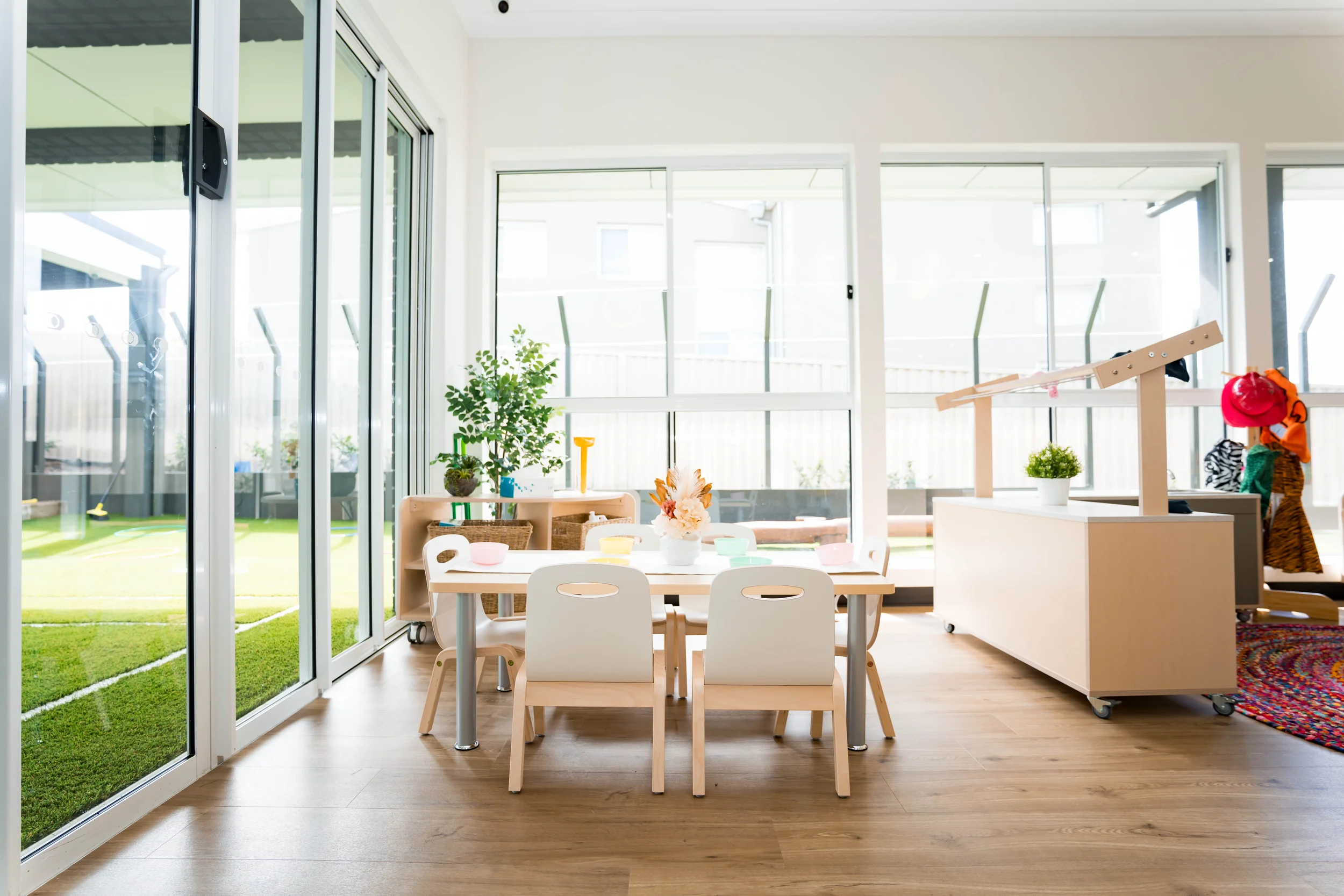
Preschool days involve movement between different spaces and types of activity.
Children may paint, build, listen to stories, participate in music, explore water, run outdoors, use natural materials and engage in imaginative play.
The Desert Rose program describes safe outdoor environments, nature exploration, physical activity and water play alongside indoor learning experiences.
You can help your child feel comfortable with variety by giving them opportunities to:
Play outdoors in different weather conditions
Get their hands messy
Use paint, water, sand or dough
Climb and balance safely
Sit for a short story
Move between energetic and quiet activity
Wear a hat
Apply sunscreen with adult help
Change clothing when it becomes wet or dirty
Do not send your child in clothing that must remain spotless.
Preschool learning can be wonderfully messy.
The Week Before Preschool: Keep Life Predictable
The week before commencement is not the ideal time to add many other major changes.
Where possible, keep sleep, meals and family routines reasonably steady.
You do not need to discuss preschool every hour. Repeated questioning can make a child feel that something worrying must be approaching.
A short daily reminder is enough:
“Preschool is on Monday. We will take your bag and family photo. I will stay for our goodbye, and your educators will look after you.”
If your child asks the same question repeatedly, answer calmly. Repetition may be how they process the change.
Pack the Bag Together
Let your child help prepare what they will bring.
Kids Central asks preschool families to provide a water bottle, a hat, and a spare change of clothes each day. Meals and snacks are prepared by the centre, and sunscreen is included among the published daily provisions.
Your child’s bag may need:
A labelled water bottle
A labelled sun hat
Several changes of clothing
Underwear or other toileting supplies as advised
Weather-appropriate clothing
A family photograph
An approved comfort item
Any medical items arranged with the centre
A bag your child can recognise
Label everything clearly.
Preschool rooms contain many similar hats, bottles, jumpers and bags. Labels help educators return items and help children begin recognising their belongings.
Choose practical clothing
Your child should be able to play, move and participate without worrying about damaging special clothing.
Consider:
Elastic waists
Shoes suitable for active play
Clothing that supports toileting
Layers that can be added or removed
Items that can cope with paint, water, sand and food
A hat that stays reasonably secure
Clothing can support independence or make it unnecessarily difficult.
The First Morning: Calm Is More Helpful Than Perfect
The first morning may not go according to plan.
Your child may wake early, refuse breakfast, become upset at the door or suddenly say they do not want to go.
That does not mean the preparation failed.
Try to keep your own language steady:
“You do not want me to go. You wish I could stay.”
“Sarah will help you. I will come back after your preschool day.”
“You can hold your photo while we say goodbye.”
Naming the feeling does not make it larger. It tells your child that you understand.
Share important information at handover
Tell the educator if your child:
Slept poorly
Ate less than usual
Is worried about something
Had a difficult morning
Has a change in collection arrangements
Is recovering from an illness
Has a new medication or medical instruction
Experienced something significant at home
A brief update helps the educator interpret the child’s behaviour more accurately.
Keep the goodbye clear
A goodbye routine might include:
Placing the bag away
Greeting the educator
Looking at the day’s activity
One cuddle
One consistent sentence
Leaving after the handover
For example:
“I love you. Sarah will look after you. I will come back after afternoon tea.”
Long goodbyes can sometimes increase uncertainty because the child repeatedly believes you may be about to leave, only to see you remain.
However, do not rush away before the educator is ready to support the handover.
Work together.
What If Your Child Cries?
Crying at separation does not automatically mean preschool is wrong for your child.
It tells us that the separation is difficult at that moment.
Some children cry briefly and then engage. Others remain unsettled for longer. A child may cope well for several days and cry later once they fully understand the routine.
I would look at the whole pattern rather than one morning.
Ask educators:
How long did the distress continue?
What helped?
Did my child connect with an educator?
Were they able to eat, play or rest?
Were there parts of the day they enjoyed?
Did the distress return at particular transitions?
Is the pattern improving, changing or becoming more intense?
At Kids Central, family communication continues through direct conversations and the secure OWNA app, which is used for private parent updates.
If distress remains intense or appears to worsen over time, families and educators should review the approach together. A child may benefit from shorter days, further orientation, a different arrival routine or support informed by a health or allied health professional.
After the First Day: Do Not Expect a Full Report
You may have spent the whole day wondering what your child was doing.
When you collect them, it is natural to ask:
“Did you have fun?”
“What did you do?”
“Who did you play with?”
Some children will answer immediately. Others may say “nothing”, change the subject or become emotional.
A preschool day contains many experiences, and a tired child may not be able to organise them into a report.
Try smaller questions later:
“What did you see outside?”
“Was there a song today?”
“Which part of the room did you visit?”
“Did you eat something crunchy or soft?”
“Was anything difficult?”
“Would you like to draw something you remember?”
You can also share what you already know:
“I saw you building when I left.”
“Your educator said you spent time near the water play.”
This gives the child somewhere to begin.
Expect Some Feelings to Come Home
A child who holds themselves together through a new day may release their emotions once they return to the person and place where they feel safest.
You may notice:
Clinginess
Tears
Irritability
Tiredness
Increased hunger
Difficulty making small decisions
Changes in sleep
Wanting more physical closeness
Less patience with siblings
Returning temporarily to earlier behaviours
This does not necessarily mean something went wrong.
Preschool requires children to process new people, sounds, routines, expectations and relationships.
Keep afternoons simple where possible.
A snack, familiar play, outdoor movement, a quiet activity or time close to you may help more than another scheduled commitment.
The First Month: Watch for Connection, Not Perfection
Settling into preschool is not a straight line.
A child may make progress, have a difficult day and then move forward again.
Rather than asking whether they have “settled” as a yes-or-no question, look for small signs of growing connection:
Recognising an educator
Entering the room with less hesitation
Referring to another child by name
Returning to a favourite activity
Asking about preschool at home
Allowing an educator to comfort them
Eating or resting more comfortably
Showing an educator something they have made
Understanding parts of the daily rhythm
Saying goodbye with support, even when still sad
These are meaningful developments.
Trust grows through repeated experiences of being cared for and reunited with family.
Inclusion Should Be Discussed Before the First Day
When a child has a disability, developmental delay, medical condition, sensory difference or communication need, early conversations are especially important.
Do not wait until a difficulty occurs before sharing relevant information.
The centre may need time to:
Review medical plans
Understand communication systems
Adjust the environment
Arrange staff training
Consult with specialists
Plan visual supports
Consider sensory needs
Discuss safe participation
Apply for inclusion support where appropriate
Ensure emergency information is complete
Bring reports or plans that help educators understand the child, but also describe who your child is beyond those documents.
Tell us what makes them laugh, what captures their attention, how they show affection, what they avoid and what helps them participate.
Inclusion is not only about managing risk or difficulty. It is about making sure the child can belong, contribute and experience success.
Kids Central’s public child-safety commitment gives particular attention to the safety of children with disabilities, Aboriginal children and children from culturally and linguistically diverse backgrounds.
Parents Need Preparation Too
Sometimes the child appears ready before the parent feels ready.
You may feel guilty, worried, relieved, excited, or all of those things together.
None of those feelings makes you a poor parent.
You are allowing another group of adults into an important part of your child’s life. It is reasonable to need time to build trust.
You can make the transition easier for yourself by:
Attending orientation
Asking questions before commencement
Understanding how updates are shared
Knowing who to contact
Confirming authorised collectors
Reading illness and medication procedures
Planning the first day so you are not rushing elsewhere immediately
Saving the centre’s phone number
Preparing for the possibility that your child may cry
Agreeing with educators on how and when they will update you
Try not to call repeatedly within the first few minutes unless the team has asked you to do so.
Agree on a communication plan. Knowing when you can expect an update may help you leave without feeling that you have lost all connection.
What Preschool Readiness Really Looks Like
I do not judge readiness by asking whether a child can complete formal schoolwork.
For preschool, readiness may look like:
Showing curiosity
Beginning to trust adults outside the family
Communicating needs in any effective way
Participating in familiar routines
Exploring materials
Playing near or with other children
Accepting support
Trying a simple self-care task
Recovering after frustration with help
Listening for a short period
Moving between active and quiet experiences
Being interested in what other people are doing
A child does not need to demonstrate every one of these consistently.
Preschool helps these capacities develop.
The Kids Central Transition to School Program later builds towards primary school through social, emotional, physical and cognitive development, individualised learning, play, independence, early literacy and numeracy. Preschool preparation should not rush children towards the final stage before they have had time to experience the stage they are entering.
Questions Parents Commonly Ask Before Preschool
What if my child has never been away from me?
Tell the centre early and make full use of orientation. Practise short separations with a trusted person where possible. Your child may need a slower relationship-building process, and that is not unusual.
Should I leave quickly even if my child is crying?
The goodbye should be clear rather than secretive, but the handover also needs to be supported. Make sure an educator is ready, use a consistent goodbye and leave once your child is safely connected with the team.
What if my child is not fully toilet-trained?
Discuss their current stage honestly with the centre. Share the words and signs they use, pack spare clothing and avoid shame. The service can explain its routines and what it needs from your family.
Can my child bring a family photo?
A family photo can offer a useful connection with home and is one of the settling supports we may suggest. Ask how the preschool would like it provided and where it can be kept.
What if English is not my child’s first language?
Continue using the language in which your family communicates most naturally. Give educators keywords, pronunciation guidance and information about what your child understands. Communication and belonging can be supported in more than one language.
Should my child know the alphabet before starting?
No. Interest in letters may develop naturally, but preschool preparation should not become an academic race. Reading together, talking, singing, drawing, playing, and involving children in everyday life provide a rich foundation.
What if my child says they do not want to return?
Listen without immediately dismissing the feeling or assuming something serious has occurred.
You might say:
“You do not want to go tomorrow. Tell me what part feels hard.”
Then speak with the educators. The child may be reacting to separation, tiredness, a difficult social moment, an unfamiliar routine or something else that needs attention.
How long does settling take?
There is no universal timeframe.
Look at whether your child is gradually forming relationships, participating and recovering from distress. Stay in communication with the centre rather than comparing their timeline with another child’s.
Preparing for Preschool at Kids Central Edensor Park
The Desert Rose Preschool Program at Kids Central supports children aged four to five through qualified educators, play-based learning, planned and child-led experiences, indoor and outdoor activities, nutritious meals, family communication and transition-to-school support.
Our Edensor Park centre is located at 79 Swan Road and operates from 7.00 am to 6.00 pm, Monday to Friday. The centre describes purpose-built learning spaces, hands-on resources, secure access, regular safety practices and active family partnerships.
Before your child begins, we want time to get to know them.
Orientation, family information, familiar words, home routines, and small supports, such as a family photo, all help us understand the person joining our preschool community.
You can help by telling us the things only your family may know:
What makes your child feel proud?
What do they find difficult to explain?
Which experiences draw them in?
How do they ask for comfort?
What would help them feel that their family and culture belong in the room?
Those conversations matter far more than arriving with a child who appears perfectly prepared.
The Most Important Preparation Is Trust
You cannot prepare your child for every moment they will experience at preschool.
There will be unfamiliar sounds, new relationships, frustrating situations, exciting discoveries and days that feel easier than others.
The goal is not to remove all uncertainty.
It is to help your child understand that:
They can ask for help
Their educators will learn about them
Their feelings will be taken seriously
Home is still connected to preschool
You will return
They are allowed to learn gradually
AtKids Central Early Learning Centre Edensor Park, we welcome families to visit before commencement, meet our educators and explore the preschool environment.
Bring your questions. Tell us what you are looking forward to and what concerns you.
Your child does not need to prove that they are ready for us.
Our responsibility is to be ready to welcome, understand and support them.