
How to Choose the Right Preschool in Colyton
A preschool tour can show you a great deal in half an hour.
You may see bright rooms, carefully arranged resources and children involved in activities. Someone may explain the program, show you the outdoor area and hand you information about fees and enrolment.
What a short tour cannot always show you is how the centre responds when a child is upset, how well educators know the children or whether the daily routine will genuinely suit your family.
That is why learning how to choose the right preschool involves more than finding the most impressive building or the longest list of inclusions.
The right preschool should give your child a safe place to build relationships, explore ideas, become more independent and remain fully themselves. It should also give you confidence that educators will listen when you share something important.
I would never expect the same preschool to suit every family in Colyton. Children have different temperaments, communication styles, cultures, interests and support needs. Families also need different days, hours, locations and levels of flexibility.
Your decision should begin with your child and your real week, not with a generic idea of what the “best” preschool is supposed to look like.

First, Understand What You Are Comparing
Parents use the word “preschool” to describe several types of early learning.
In New South Wales, families may consider a community preschool, a public preschool or a preschool program delivered within a long day care service. The NSW Department of Education confirms that many long day care services provide preschool programs and advises families to consider the service type, required days and hours, location, quality rating, cultural inclusion and health needs when choosing care. (education.nsw.gov.au)
The educational purpose may overlap, but the practical arrangements can be different.
A traditional preschool may operate during school hours or school terms. A preschool program within long-day care may provide longer weekday hours and care across more weeks of the year.
Neither format is automatically better.
A community preschool may work beautifully for a family whose schedule fits its sessions. Long-day care may make more sense when parents need care before and after traditional preschool hours, during school holidays, or across several regular working days.
Before comparing individual services, ask:
Which days do we genuinely need?
What time must drop-off be possible?
What is the latest realistic collection time?
Do we need care during school holidays?
Who will normally handle drop-off and collection?
Is the location practical from home, work or a relative’s home?
Would a shorter preschool session or a long daycare program suit us better?
How many changes could our child comfortably manage during one day?
A preschool can offer an excellent educational program and still be the wrong practical choice for your household.
Write Your Family’s Brief Before Reading Centre Brochures
Preschool websites can quickly fill your head with other people’s priorities.
You may begin to think you need the largest playground, the newest equipment, or a long list of extracurricular activities before asking whether those things matter to your child.
I recommend writing a simple family brief first.
Do not begin with features. Begin with needs.
What does your child need from adults?
Think about how your child approaches unfamiliar people.
Do they form relationships quickly or watch for a long time before engaging? Do they actively ask for help or become quiet when they are unsure? Do they need an adult to remain physically close before exploring independently?
A child who confidently talks with new adults may settle into a room differently from a child who communicates mainly after trust has developed.
Neither child is more ready for preschool.
You are looking for educators who can recognise the difference.
What does your child need from the environment?
Some children enjoy busy spaces and move easily between several activities.
Others become overwhelmed by noise, crowded areas or rapid transitions. They may need a quieter place, predictable routines or more time to understand what is happening.
Consider whether your child:
Seeks movement and physical challenge
Prefers small groups
Needs somewhere quiet to reset
Enjoys messy or sensory play
Avoids particular sounds or textures
Becomes deeply involved in one activity
Finds sudden changes difficult
Enjoys outdoor experiences
Needs visual information or repeated instructions
These observations do not need to become labels. They help you notice whether a preschool has enough flexibility for different children.
What matters to your family?
Your priorities may include:
Cultural and religious respect
Home-language support
School preparation
Nutritious meals
Outdoor learning
Qualified educators
Communication
Inclusion
A gradual orientation process
Support for an allergy or medical condition
Relationships with the local community
Consistent educators
Care for siblings at the same location
Put those priorities in order.
A list of everything you could possibly want is less useful than identifying the few things that would genuinely affect your child’s experience.
Use Official Information to Build a Shortlist
A centre’s website tells you how it wants to present itself.
Official information gives you another perspective.
TheStartingBlocks childcare finder allows families to search for approved education and care services, compare available information and view published National Quality Standard ratings. StartingBlocks explains that most services receive an NQS rating and that the rating is one tool families can use when choosing care. (startingblocks.gov.au)
The National Quality Standard covers seven areas:
Educational program and practice
Children’s health and safety
Physical environment
Staffing arrangements
Relationships with children
Partnerships with families and communities
Governance and leadership
Services are assessed against those areas and receive individual area ratings and an overall rating. (acecqa.gov.au)
A rating can help you identify questions, but it should not make the whole decision for you.
The assessment may not capture every recent staff change or every part of your child’s individual experience. A service may also be awaiting its first assessment.
This is particularly important when considering a new centre.
Kids Central Colyton is currently scheduled to open in 2026. The public website confirms that Expressions of Interest are open, but it does not yet publish a Colyton service approval, quality rating, street address or exact opening date. (kidscentralelc.com.au)
Once the centre is approved and operating information becomes available, families should check the Colyton service’s official record rather than assuming that another location's rating automatically applies.
The Way Educators Speak With Children Matters Most
Parents can become distracted by buildings and resources during a tour.
I understand why. Those are the easiest things to see.
However, the part I would watch most carefully is how educators speak with children when no one appears to be presenting something specifically for you.
Notice whether educators:
Come down to a child’s level
Use children’s names
Pause and allow a child to respond
Notice gestures and facial expressions
Speak respectfully during care routines
Help children enter play
Respond calmly to strong emotions
Explain boundaries rather than relying only on commands
Show interest in children’s ideas
Offer help without immediately taking over
You may see a child crying. That does not automatically indicate a poor environment.
Young children cry for many reasons. Separation, tiredness, frustration, hunger, conflict and unexpected change are all normal parts of childhood.
The useful question is what the educator does next.
Do they dismiss the feeling, distract the child immediately or tell them there is nothing wrong?
Or do they try to understand, offer comfort and remain available while the child regains a sense of safety?
The National Quality Standard describes responsive and respectful relationships as central to children’s security and belonging. It also connects qualified and experienced educators with predictable environments and active participation in learning. (acecqa.gov.au)
Those principles should be visible in ordinary interactions.
Ask Who Will Actually Work With Your Child
A tour may be led by a manager or enrolment representative.
That person matters, but they may not spend most of the day in your child’s room.
Ask to meet the educators who are expected to work with the preschool group. Find out who leads the educational program and how leadership supports the room team.
Useful questions include:
Who is the early childhood teacher?
Who will lead the preschool room?
What qualifications do the educators hold?
How long have they worked together?
How will new educators be introduced?
What happens when a regular educator is absent?
How does the centre support professional development?
Who should families speak with about learning or development?
How involved is the centre manager in daily practice?
Under the National Quality Framework, educators who count towards the required staffing must meet qualification requirements. Other than diploma-qualified educators, staff counted towards ratios must generally hold or be actively working towards at least an approved Certificate III qualification. Centre-based services must also engage with, or have access to, an early childhood teacher based on attendance numbers. (acecqa.gov.au)
Qualifications matter because early childhood education involves more than supervising activities.
Educators need to understand:
Child development
Learning through play
Observation and planning
Health and safety
Inclusive practice
Communication
Emotional wellbeing
Behaviour as communication
Professional responsibilities
Working with families and external professionals
Experience and warmth matter too.
A qualification does not automatically make every interaction thoughtful. An educator without patience or curiosity may struggle to build meaningful relationships.
Look for professional knowledge and humanity together.
Understand Ratios Without Treating Them as the Full Answer
For children aged 36 months through preschool age in New South Wales, the minimum centre-based ratio is generally one educator for every ten children.
ACECQA explains that ratios are calculated across the whole service rather than being fixed separately in each room. Educators must be physically present and directly involved in providing education and care to count, and adequate supervision must still be maintained. (acecqa.gov.au)
This is why asking only “What is the ratio?” may not tell you enough.
Ask how staffing works when:
Children arrive and leave
Educators take breaks
Part of the group moves outdoors
A child needs help in the bathroom
An incident requires one educator’s attention
Several children need emotional support at once
Meals are served
Children move between experiences
A staff member is absent
A child requires additional assistance
A service may meet the legal minimum and still organise its educators in ways that feel stretched at particular times of day.
Conversely, a thoughtful team may arrange people and spaces so children remain well supported during complicated transitions.
I would pay attention to whether educators appear constantly rushed.
Preschool can be active and noisy. That is normal. A team should still have enough capacity to notice children rather than moving from one urgent task to the next all day.
Ask the Centre to Explain Its Program Without Using Brochure Language
Most preschool services will describe their program as child-centred, play-based or holistic.
Those terms can represent strong practice, but they can also remain vague unless the centre explains what they mean.
Ask for a recent example.
You might say:
“Can you show me how an interest from the children became part of the program?”
A useful answer might describe children noticing insects outdoors, educators adding books and observation tools, families contributing knowledge, and the group returning to the subject over several days.
That tells you more than seeing “science activity” written on a weekly planner.
Play-based learning should still involve educators
Play-based learning does not mean children are left to occupy themselves without guidance.
Educators observe, listen and make decisions about what might extend the learning.
They may:
Introduce new vocabulary
Add materials
Ask a question
Help children recall an earlier experience
Support a social negotiation
Demonstrate the safe use of a tool
Record what they notice
Adapt an experience so another child can participate
Plan what could happen next
Kids Central’s existing Desert Rose Preschool Program combines structured and unstructured experiences, indoor and outdoor play, stories, music, creative activity and educational games. The program describes learning as mainly play-based while supporting cognitive, emotional, social and physical development. (kidscentralelc.com.au)
The announced Colyton centre is expected to provide school-readiness support and environments designed for different ages and stages. Detailed Colyton programming has not yet been published, so families should ask how these principles will appear once the service opens. (kidscentralelc.com.au)
Look for Learning That Is Broader Than Finished Craft
It is easy to notice paintings, worksheets or matching activities because they create something visible.
Some of the most valuable preschool learning is less obvious.
A child may be learning to:
Explain an idea
Ask another child to join
Cope when a plan does not work
Wait for a useful moment to speak
Persist with a difficult construction
Recognise when someone needs help
Manage belongings
Negotiate rules
Use language to solve a disagreement
Move safely through a shared space
Recover after disappointment
A centre should be able to talk about these forms of learning.
I would be cautious if every child is expected to create an almost identical product.
A room displaying thirty matching pieces may show that adults organised an activity efficiently. It does not necessarily show what decisions the children made.
Creative experiences can involve techniques, tools and educator guidance while still leaving room for different ideas.
Ask yourself:
“Can I see the child’s thinking here, or mainly the adult’s example?”
Decide What School Readiness Means to You
“School readiness” is one of the most heavily marketed preschool phrases.
Families deserve a clear explanation of what the centre means by it.
I do not believe school readiness should be reduced to worksheets, handwriting practice or remembering academic facts.
Children are preparing for school when they develop the ability to:
Communicate a need
Ask for help
Participate in a group
Form relationships with unfamiliar adults
Care for belongings
Manage toileting with growing independence
Listen to another person
Follow a short sequence
Cope when an activity ends
Persist with something challenging
Move confidently
Express ideas
Become curious about books, language, numbers and patterns
The NSW Department of Education reminds families that children develop at different rates and recommends working with early childhood educators to set learning goals, attending orientation, and gradually building routines and independence before Kindergarten. (education.nsw.gov.au)
Kids Central’s existing Transition to School Program takes a broad approach that includes social, emotional, physical and cognitive preparation as well as early literacy and numeracy. It also identifies play, individual planning, confidence, independence and familiarity with school routines as parts of the transition. (kidscentralelc.com.au)
Ask a preschool:
How is school readiness included in ordinary play?
How do you support confidence and independence?
How do you introduce early literacy and numeracy?
How do you avoid putting academic pressure on children?
How do you share developmental information with families?
How are individual learning goals decided?
How do you communicate with schools where appropriate?
How do you support a child who needs additional help with the transition?
A useful program should prepare children for school without making them spend their preschool year pretending they are already in primary school.
Look at How the Environment Is Used
A purpose-built centre can create excellent opportunities, but architecture alone does not guarantee meaningful learning.
The useful question is what children can do within the space.
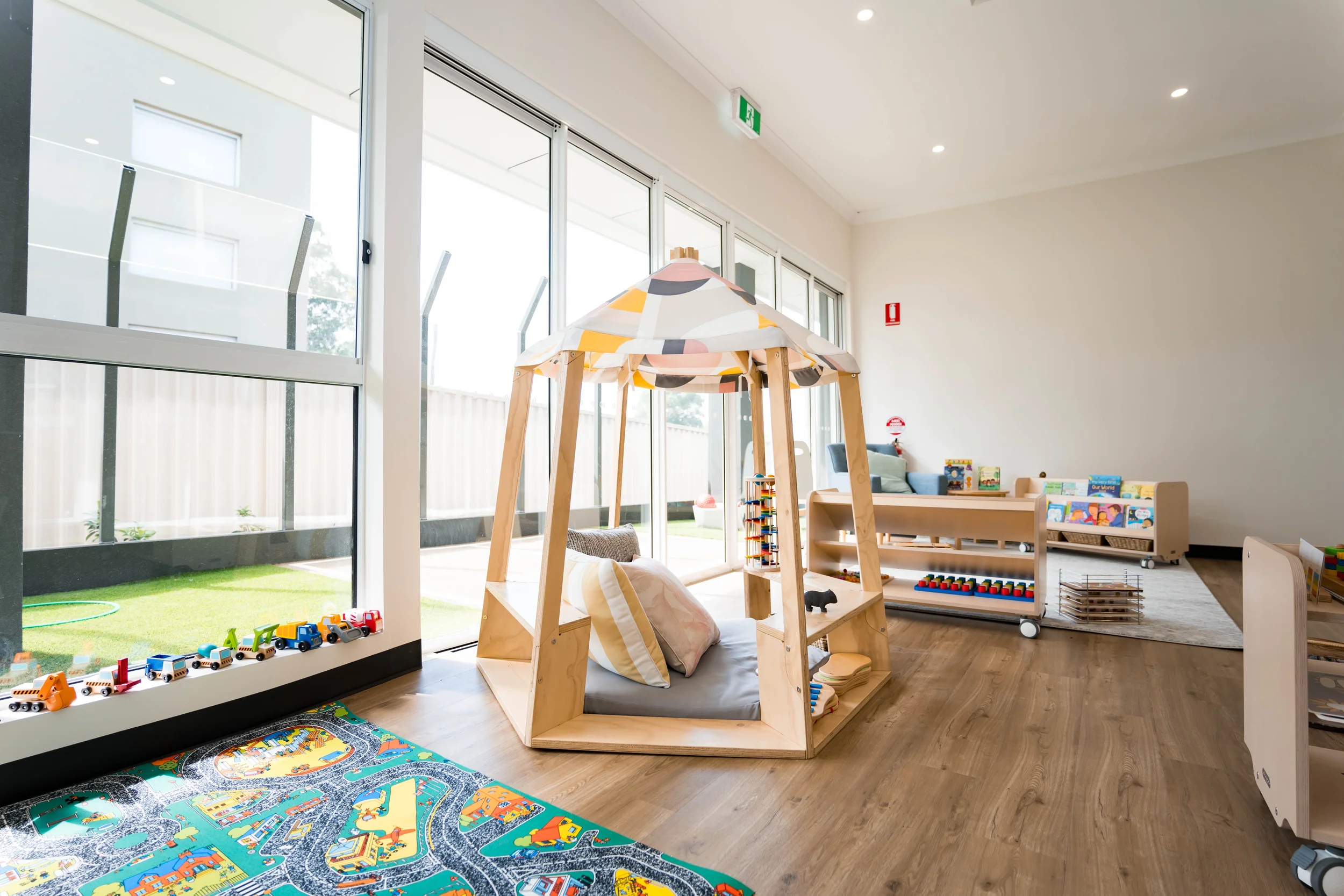
Indoor areas should offer different ways to participate
Not every child wants to be part of a large, energetic group all day.
A well-planned room may include areas for:
Construction
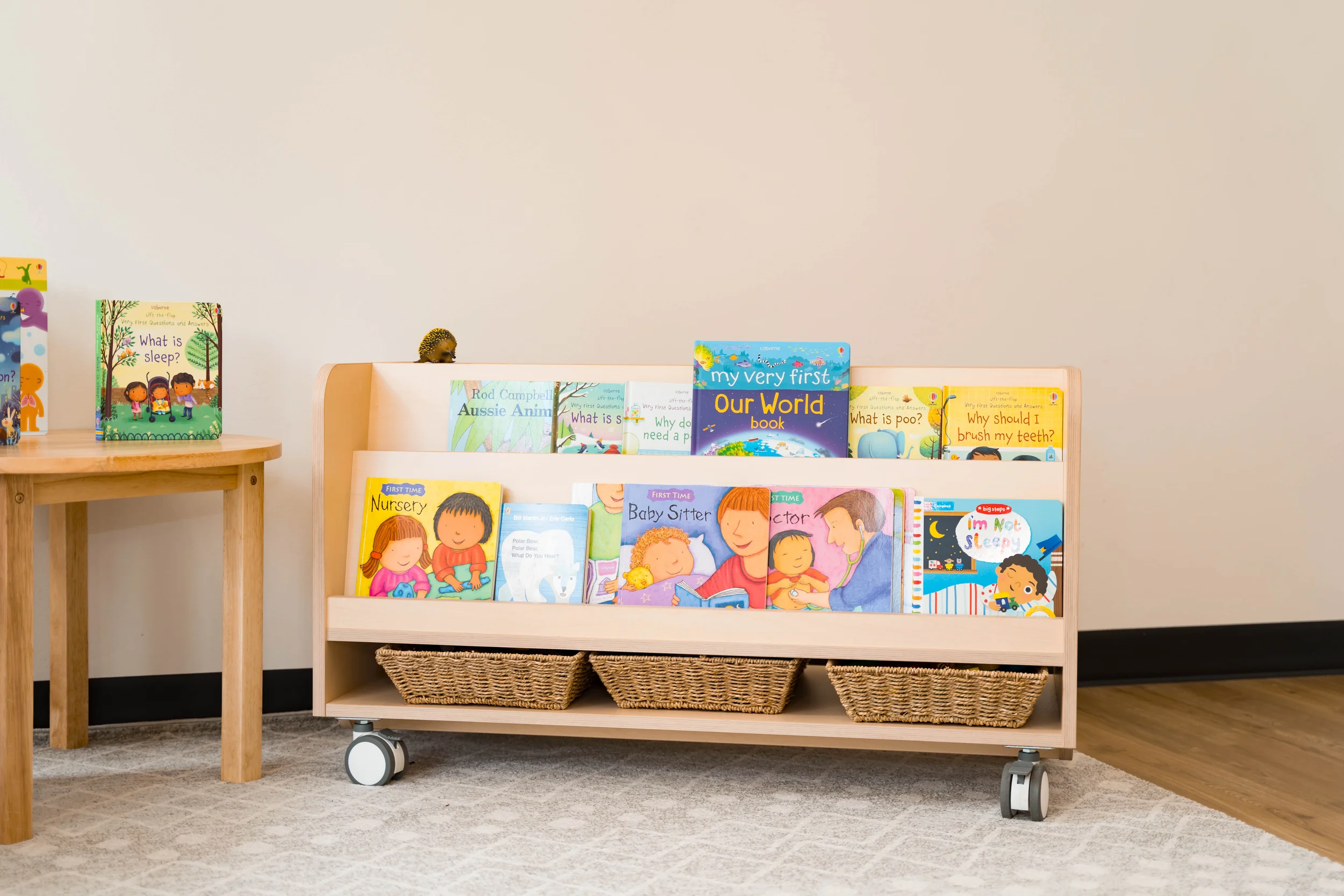
Books and storytelling
Creative work
Dramatic play
Sensory exploration
Small-group conversation
Puzzles and problem-solving
Rest or quiet observation
Music and movement
Materials chosen independently by children
Resources should be accessible enough for children to make choices rather than waiting for an adult to distribute every item.
The room should also allow educators to supervise without making children feel constantly controlled.
Natural resources should do more than decorate the room
Natural and open-ended resources can include timber, stones, leaves, shells, sand, water, fabric and recycled materials.
Their value is not simply that they look attractive.
They can be used in multiple ways.
A piece of timber may become a bridge, a road, part of a house or an object within a story. Stones may be sorted, balanced, counted, transported or used during imaginative play.
These materials allow children to bring more of their own thinking to an experience.
Ask whether resources are available for children to use freely and creatively or are mainly placed on shelves as decoration.
Outdoor learning should be planned
An outdoor area should offer more than fixed equipment and a place to run.
Children can learn outdoors through:
Gardening
Water and sand
Construction
Nature observation
Drawing
Movement
Imaginative play
Safe physical challenge
Cooperative games
Quiet conversation
Experiences that change with the weather
Kids Central’s current preschool program describes safe outdoor spaces, physical activity, nature exploration and water play. The future Colyton service is announced as having purpose-built, age-appropriate environments, although its final layout has not yet been publicly detailed. (kidscentralelc.com.au)
During a future Colyton tour, ask how often children can move between indoor and outdoor spaces and what happens outdoors across an ordinary week.
Safety Should Be Explained, Not Merely Promised
Every preschool will say that children’s safety comes first.
A trustworthy service should be willing to explain what that means.
Ask about:
Secure entry
Authorised collection
Supervision
Child-protection responsibilities
First aid
Medication
Allergies
Illness
Emergency procedures
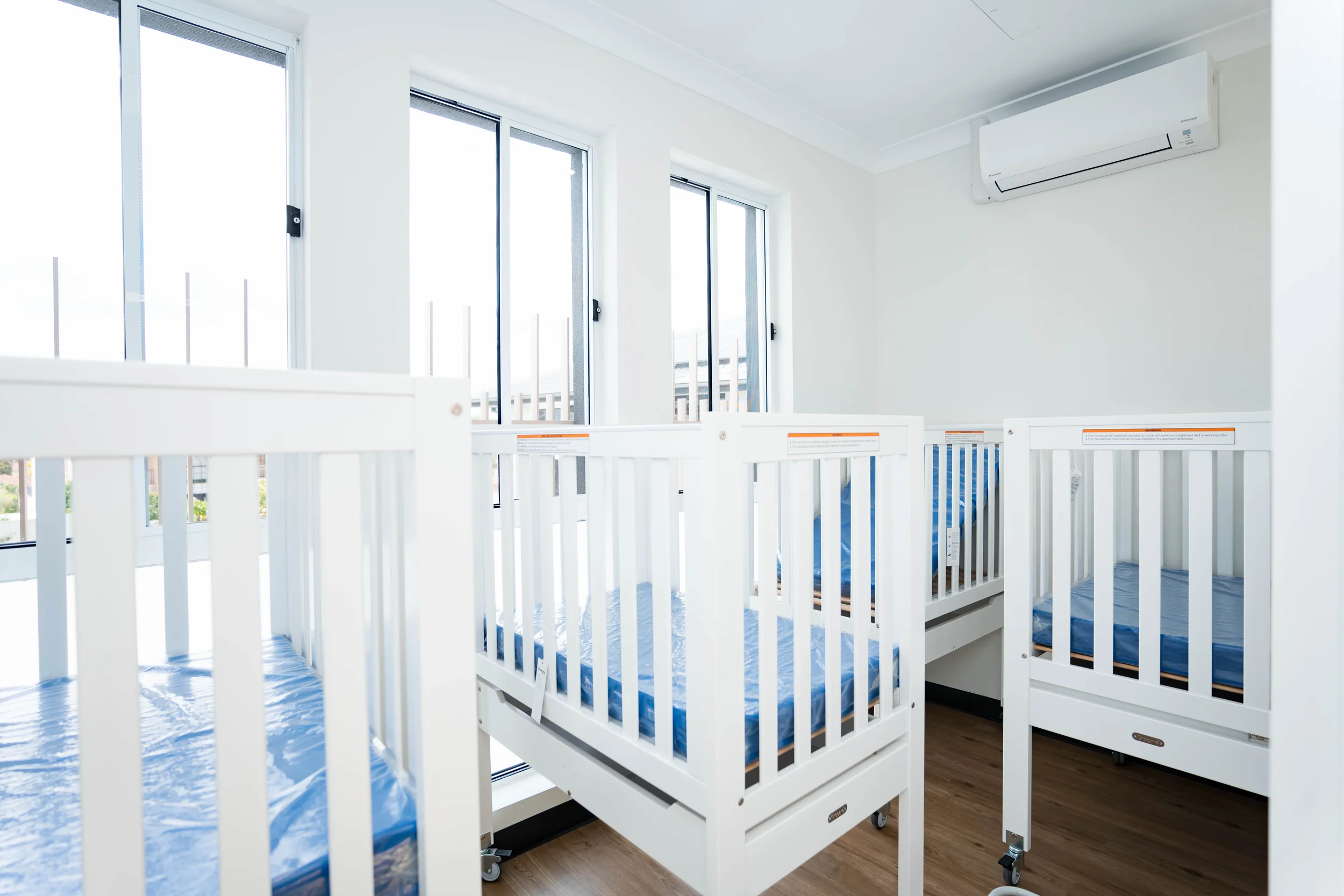
Sleep and rest
Toileting
Hygiene
Cleaning
Sun protection
Photography and personal devices
Incident reporting
Complaints and concerns
The National Quality Standard includes children’s health, safety and wellbeing as a full quality area. It also addresses physical environments, staffing, relationships, family partnerships and leadership. (acecqa.gov.au)
Kids Central’s public Colyton announcement refers to secure entry, regular health and safety checks, background checks and ongoing staff training in emergency procedures. Families should still ask how those commitments will operate in the new centre once detailed policies and staffing are available. (kidscentralelc.com.au)
Notice how personal care is discussed
Children deserve dignity during toileting, changing, rest and illness.
Listen to the language educators use.
A child should not be embarrassed for having an accident, needing help or not progressing at the same rate as another child.
Ask:
How do you support children still developing toileting independence?
What happens after an accident?
How is privacy balanced with supervision?
How do you communicate with families about toileting?
What if my child is afraid of an unfamiliar bathroom?
What spare clothing should we provide?
The answer should sound calm and practical, not judgemental.
Check Whether Inclusion Is Part of Daily Practice
A preschool may say that every child is welcome.
The next question is whether every child can participate.
A child may need support related to:
Disability
Development
Communication
Sensory processing
Behaviour
Medical care
Mobility
Home language
Culture
Religion
Family circumstances
Emotional wellbeing
Meaningful inclusion may involve visual information, changes to the environment, extra processing time, different equipment or collaboration with allied health professionals.
Ask:
How early can we discuss support needs?
Who coordinates individual support?
Can educators work with therapists or other professionals?
How are visual supports used?
How would an activity be adapted?
What happens if my child cannot participate in the usual way?
How do you apply for or use inclusion support?
How are other children helped to understand differences respectfully?
How will our family contribute to planning?
Kids Central’s child-safety commitment specifically recognises Aboriginal children, children from culturally and linguistically diverse backgrounds and children with disabilities. Its Colyton page also states that family feedback and involvement will help programs meet children’s needs. (kidscentralelc.com.au)
I would listen closely to whether the centre focuses mainly on what the child cannot do or on how the environment and educators can support participation.
Make Sure Home Language and Culture Are Respected
A child should not have to leave their family identity at the preschool entrance.
Tell the centre which languages your child understands and uses. Share keywords that may help during meals, toileting, rest or emotional moments.
Ask whether the preschool:
Learns correct name pronunciation
Uses family contributions respectfully
Includes different cultures in everyday resources
Represents different family structures
Supports home languages
Understands religious or cultural practices
Provides ways for families to share knowledge
Avoids stereotypes
Responds appropriately to discrimination or exclusion
Cultural inclusion should not be limited to festivals.
It should influence how educators listen, plan, communicate and respond throughout the year.
You should not be expected to represent an entire culture. You should simply be able to explain what matters to your child and family.
Ask How the Centre Helps Children Settle
A child’s first relationship with preschool begins before the first full day.
I would be cautious of any service that treats orientation as a quick administrative walk-through.
Orientation is a chance for:
Your child to recognise the environment
Educators to begin learning their communication
Families to share routines
A child to meet the adults who will care for them
Questions to be answered without the pressure of a full day
Comfort strategies to be discussed
The first separation plan to be considered
At Kids Central, orientation and time spent getting to know the child before commencement form part of the intended settling approach.
We may suggest bringing a family photograph. A familiar photo can give the child a visible connection with the people who will return for them.
Ask each preschool:
How many orientation visits are available?
Can a parent stay during orientation?
Can visits be adjusted for a cautious child?
Who will spend time getting to know my child?
Can we bring a family photo or comfort item?
What should I tell you about separation?
How will you contact me if my child remains distressed?
Can shorter initial days be discussed?
How will you help my child reconnect after an absence?
There is no guarantee that every child will settle immediately.
The quality of the answer lies in whether the centre is prepared to learn about your child, rather than expecting a single routine to work for everyone.
Communication Should Continue After Enrolment
Some centres communicate very well while trying to fill a place, and become much harder to reach once the child starts.
Ask how communication works during ordinary weeks.
You may want information about:
Meals
Rest
Toileting
Activities
Friendships
Interests
Learning
Emotional wellbeing
Incidents
Health
Changes educators have noticed
Digital updates can be useful, but they should not be your only connection with the service.
You should know who to approach for a proper conversation.
Ask:
Is there a family communication app?
Who responds to messages?
How are urgent matters handled?
How will educators tell me about a difficult day?
When can I discuss development privately?
How are incidents reported?
How can families contribute ideas?
How are concerns escalated?
How does management respond to feedback?
How will I know if staffing changes?
Kids Central’s current preschool program refers to regular updates through its app, while the Colyton announcement emphasises family partnerships, communication, feedback and participation. (kidscentralelc.com.au)
An app can tell you what your child ate.
A relationship helps you understand how they feel and how they are developing.
You need both practical information and people who are prepared to talk.
Read the Menu, Then Ask About the Mealtime
Parents should ask what food is provided, but choosing a preschool involves more than checking whether vegetables appear on the menu.
Find out:
Where meals are prepared
How the menu is planned
How often it changes
How allergies are managed
How cultural and religious needs are supported
What happens when a child refuses food
How sensory feeding needs are approached
Whether children are pressured to eat
How families receive information
What drinks are available
What families need to provide
The future Kids Central Colyton centre has announced that healthy daily meals will be included, along with nappies, wipes and sun-safety provisions. A detailed Colyton menu has not yet been published. (kidscentralelc.com.au)
Mealtimes should support health, but they are also social and educational experiences.
Children can practise using utensils, pouring water, talking with others, recognising hunger and trying unfamiliar food without pressure.
A child should not be described as difficult simply because eating is complicated for them.
Families and educators need to share information and agree on a safe, respectful approach.
Test the Preschool Against Your Real Week
A centre can feel wonderful during a quiet tour but become difficult to use on a working day.
Before enrolling, test the practical arrangement.
Travel the route at the right time
Do not rely only on a map estimate.
Travel from home to the preschool during the time you would normally drop off. Then consider the journey towards work, another child’s school or a family member’s home.
Ask:
Is parking manageable?
How much time will drop-off take?
Can a grandparent or authorised carer manage the route?
What happens when traffic is heavier?
Is the entrance safe with more than one child?
Does collection fit the working day?
Are the operating hours confirmed?
The current Kids Central Colyton page has not yet published the centre’s street address or its operating hours in Colyton. Those details should be checked before a place is accepted. (kidscentralelc.com.au)
Confirm the exact days available
Do not assume that submitting preferred days guarantees those days.
Ask:
Which days are available?
Is there a minimum number of days?
Can days be changed later?
How are additional days requested?
What happens when a family’s work schedule changes?
Are places offered for the whole year?
How are absences and holidays handled?
TheKids Central Colyton Expression of Interest currently allows families to identify the weekdays they are seeking. Formal availability and enrolment arrangements should be confirmed directly when offers begin.

Compare the Full Cost, Not Only the Daily Fee
The cheapest advertised fee is not automatically the lowest real cost.
Ask what the daily fee includes.
Possible inclusions may cover:
Meals
Nappies and wipes
Sunscreen
Linen
Educational programs
School-readiness support
Special activities
Excursions
Communication platforms
Also ask about:
Enrolment fees
Deposits
Late collection charges
Public holidays
Absence charges
Notice periods
Additional activity costs
Fee increases
Child Care Subsidy processing
Kids Central has announced that Colyton will include healthy meals, nappies, wipes and sun safety. A Colyton fee schedule has not yet been made public. (kidscentralelc.com.au)
Request written information before committing.
A clear service should be able to explain what you will be charged, when fees are due and what happens when your child does not attend.
Be Thoughtful When Comparing a New Centre With an Established One
A new centre can offer real advantages.
The spaces may be purpose-built around current expectations. Families may join at a similar time and help shape the developing community. Resources and equipment may be new.
A new centre also brings questions that an established service may already be able to answer through its history.
Ask:
Who will lead the opening?
When will educators begin working together?
How will the team establish shared practices?
Will enrolments begin gradually?
How will orientation be scheduled?
Are policies available before opening?
How will early feedback be gathered?
What happens if the opening date changes?
When will the service approval be confirmed?
When can families tour the finished environment?
How will children be supported as everyone learns new routines?
Do not assume that a new centre will be disorganised.
Do not assume that a new building guarantees quality either.
Leadership, preparation and communication will matter enormously during the first months.
Green Flags to Notice During Your Search
No single sign proves that a preschool is right, but the following combination is encouraging:
Educators know children’s names and interests
Adults speak respectfully, including during difficult moments
Children approach educators for help
The environment includes busy and quiet options
Resources are accessible and used in different ways
The program can be explained through real examples
Staff answer detailed questions without becoming defensive
Family knowledge is treated as valuable
Home language and culture are welcomed
Inclusion is discussed in terms of participation
The centre is honest about what it can and cannot provide
Safety procedures are clearly explained
Orientation can respond to the individual child
Communication continues beyond the enrolment process
Educators appear supported by leadership
School readiness includes emotional, social, physical and communication development
Children’s work and play do not all look identical
Mealtimes and personal care are discussed respectfully
The strongest impression may not be excitement.
It may be relief.
You may feel that you do not need to present your child as easier, more independent or less complicated than they really are.
Signs That Deserve Another Question
A concern does not always mean you must immediately reject a service, but it should not be ignored.
Ask more when:
Educators appear too rushed to respond
Most communication is directed at adults rather than children
Children are expected to complete identical work
School readiness is explained mainly through worksheets
The centre cannot clearly identify the preschool teacher
Staff changes are dismissed as unimportant
Questions about ratios receive vague answers
Distress is described as misbehaviour
Toileting accidents are discussed with embarrassment
Families are expected to stop using their home language
Inclusion is reduced to whether the centre accepts enrolment
The environment has few quiet or flexible spaces
Safety answers remain broad
Allergies or medical needs are treated casually
The fee structure is difficult to obtain
Orientation is limited to paperwork
Parents are discouraged from raising concerns
Marketing claims are much more specific than the information available during a tour
Trust your response, but also investigate it.
Sometimes a question leads to a reassuring explanation. Sometimes it confirms that the service and family are not the right fit.
Both outcomes are useful.
A Simple Way to Compare Your Final Options
Once you have visited several preschools, the information can begin to blur.
Create a comparison using the same headings for each service:
Relationships
Did educators respond warmly and respectfully? Could I imagine my child asking these people for help?
Program
Could the centre explain how children’s interests and development influence planning?
Educators
Who will work with my child? What are their qualifications and experience? Does the team appear stable and supported?
Inclusion
How would the centre respond to my child’s language, culture, medical needs, development or disability?
Environment
Are there active, quiet, indoor and outdoor opportunities? Can children reach and use resources independently?
Safety
Were procedures explained clearly? Did the environment feel supervised and organised?
Settling
Is orientation meaningful? Will educators learn about my child before expecting them to manage a full day?
Communication
Will I know who to speak with? Is there room for a proper conversation?
School readiness
Does the program support the whole child or concentrate mainly on academic performance?
Practical fit
Do the location, hours, days, fees and inclusions work for our household?
You can score each category, but do not let a total number hide one non-negotiable issue.
A centre may score well overall but still be unable to safely meet an essential medical or support need.
Questions to Take to a Colyton Preschool Tour
You do not need to ask every question in one conversation. Select the ones that matter most to your family.
About the people
Who will work directly with my child?
Who is the early childhood teacher?
What qualifications does the team hold?
How long have educators worked together?
How does management support the room?
How are staffing changes communicated?
About the program
How is the preschool program planned?
Can you show me an example based on children’s interests?
How much time do children spend outdoors?
How do you balance child-led and educator-guided experiences?
What does school readiness look like here?
How do you share information about learning?
About settling
How many orientation visits can we attend?
Can visits be adjusted to my child?
How will educators learn about home routines?
Can my child bring a family photo?
What happens if separation remains difficult?
When will you contact me?
About inclusion
How do you support children with additional needs?
Can you work with allied health professionals?
How are home languages included?
How do you adapt experiences?
How is inclusion support coordinated?
How are cultural and religious practices respected?
About health and safety
How does secure entry work?
Who can collect my child?
How are allergies and medication managed?
What happens when a child becomes unwell?
How are incidents communicated?
How are toileting and personal care handled?
What child-protection training does the team complete?
About daily life
What meals are provided?
How is rest managed?
What must families pack?
How are daily updates shared?
How much choice do children have?
Are there quieter spaces?
How are difficult social situations supported?
About enrolment
What is the confirmed opening date?
What are the operating hours?
Which days are available?
What is the fee?
What is included?
What is the notice period?
What happens if the opening timeline changes?
What Kids Central Has Announced for Colyton
Kids Central Early Learning Centre is coming to Colyton in 2026 and is currently accepting Expressions of Interest.
The public announcement includes:
Education and care from six weeks to six years
Purpose-built learning environments
Experienced and nurturing educators
School-readiness support
Healthy daily meals
Nappies and wipes
Sun-safety provisions
Secure entry and health and safety practices
Family communication and community engagement
The exact address, opening date, operating hours, fee schedule, approved places, and Colyton educator team have not yet been published. (kidscentralelc.com.au)
Families canregister an Expression of Interest for Kids Central Colyton and identify the days of care they are seeking.
Registering your interest is an early step. It should not replace asking questions, visiting the centre when tours become available and confirming that the final arrangements suit your child.
Common Questions About Choosing a Preschool in Colyton
Should I choose the preschool closest to home?
Location matters because the journey will become part of your weekly routine. It should not be the only factor. A slightly longer journey may be worthwhile for a centre that better fits your child, but a difficult commute can put pressure on the whole family.
Is a new preschool better than an older one?
Not automatically.
A new centre may offer purpose-built spaces and new resources. An established centre may offer a proven team and longer service history. Compare leadership, educators, practices and relationships rather than relying on the building’s age.
Does the highest quality rating mean a centre is right for my child?
A strong rating is valuable independent information, but individual fit still matters. Use the rating alongside visits, questions and consideration of your child’s needs.
How many days should my child attend?
There is no universal answer.
Consider your family schedule, your child’s temperament, affordability and how consistently they can attend. Ask the preschool how its program works across the week and whether particular experiences are repeated or continued.
Does preschool need to teach reading and writing?
Preschool should support early literacy through books, conversation, drawing, storytelling, songs, rhymes and meaningful exposure to print.
Children do not need formal academic pressure. Strong language, curiosity, confidence and positive learning experiences provide important foundations.
What if my child does not speak much English?
Continue using the language in which your family communicates most naturally. Tell educators which languages your child understands and share important words. Ask how the preschool will support communication and a sense of belonging.
What if my child has additional needs?
Raise those needs early.
Share relevant plans and professional information, but also explain your child’s interests, strengths and communication. Ask how the centre will adapt the program and how it will work with your family and other professionals.
Can I change my mind after accepting a place?
You will need to check the enrolment agreement, notice period, deposit and fee conditions. Read these carefully before signing.
The Right Preschool Should Make Room for the Real Child
You do not need to choose the preschool with the most impressive description.
You need people who will notice your child.
That means noticing when they are interested, uncertain, overwhelmed, proud, tired, ready to try or asking for help without using words.
A strong preschool will not expect your family to disappear once enrolment is complete. Educators should continue learning from you because your knowledge remains important.
At Kids Central, we want families to ask detailed questions.
We want to know what matters at home, how your child communicates, what helps them feel safe and what you hope they will experience during the preschool years.
As plans forKids Central Early Learning Centre Colyton progress, families who have registered interest will be able to consider the practical details as they become available.
Do not choose only from the photographs.
Visit when you can. Watch the relationships. Ask how the program works on an ordinary day. Listen to how the team speaks about children who need extra time or support.
The right preschool should not require your child to become someone else before they belong.
It should be ready to meet them, learn about them and help them take the next step from where they are.