
The Ultimate Guide to Childcare in Western Sydney
The first childcare decision is often made with a calendar open, work hours in front of you and several family members trying to work out who can collect on which day.
Then the larger questions arrive.
What type of care does your child need? How can you tell whether a centre is genuinely safe and well-run? What should happen in a nursery, toddler room or preschool program? How do fees and the Child Care Subsidy work? What happens if your child cries every morning or needs additional support?
I have put together this childcare Western Sydney guide to take you through the entire process, from deciding what kind of care would suit your family to helping your child settle after enrolment.
You do not need to know every childcare term before you begin.
You do need clear information, enough time to ask questions and a service that is willing to learn about your child rather than expecting your child to fit one fixed routine.

What Do We Mean by Childcare?
Families often use “childcare” as one broad term, but several types of early childhood education and care operate in New South Wales.
The main options include long day care, preschool, family day care, occasional care and some mobile or specialised services. School-aged children may also use outside school hours care and vacation care. The NSW Department of Education recommends considering your child’s age, development, health, emotional needs, culture, required hours and preferred location before choosing a service type. (education.nsw.gov.au)
Understanding the differences will help you avoid comparing services that are designed to do different jobs.
Long day care
Long day care generally operates for extended weekday hours and may remain open throughout most of the year, excluding public holidays and centre closures.
It combines daily care with an educational program.
A long day may include:
Meals and snacks
Nappy changes or toileting
Rest and sleep
Indoor and outdoor play
Stories, music and movement
Creative and sensory experiences
Planned small-group learning
Child-led investigation
Communication with families
Preschool and transition-to-school experiences for older children
Long day care can suit parents who work, study or need regular weekday care over longer hours.
It may also suit families who value having nursery, toddler and preschool programs available within the same service.
Kids Central Edensor Park, for example, operates from 7.00 am to 6.00 pm, Monday to Friday, and provides age-based programs from infancy through the preschool years. (kidscentralelc.com.au)
Preschool
Preschool usually focuses on children in the years before Kindergarten.
Some preschools operate during school terms and school hours. Others are preschool programs delivered within a long-day care centre.
Preschool should support the whole child, including:
Language
Relationships
Emotional confidence
Physical development
Independence
Early literacy and numeracy
Curiosity
Problem-solving
Participation in groups
It should not be treated as an early version of primary school.
A quality preschool program uses play, conversation, investigation and meaningful routines to prepare children for the next stage without rushing them out of childhood.
Family day care
Family day care is provided by an educator in an approved home-based setting.
The smaller group may appeal to families who prefer a home-like environment or who feel their child would be more comfortable with fewer children.
Under the National Quality Framework, a family day care educator may care for up to seven children, with no more than four preschool-aged or younger. The educator’s own children under 13 may be included in the ratio in some circumstances. (acecqa.gov.au)
Families should ask about:
The educator’s qualifications and experience
Which ages attend together
Backup care when the educator is unavailable
Outdoor access
Excursions and transport
Pets
Other adults who may be present
Sleep and supervision arrangements
How educational planning is documented
Family day care can be a warm and valuable option, but it remains different from a larger centre with a broader staff team and purpose-built rooms.
Occasional care
Occasional care may suit families who need irregular or short periods of care rather than fixed weekly days.
Availability, operating hours and eligibility vary between services.
It can support appointments, casual work, study or temporary family needs, but it may not provide the same routine and continuity as attending regular days each week.
Begin With the Job You Need Childcare to Do
Before visiting centres, write down what your family actually requires.
Do not begin with photographs, activity lists or promotional claims.
Begin with the week you live.
Ask:
How many days of care do we need?
Which days are essential?
What time must drop-off be available?
What is the latest realistic collection time?
Do we need care during school holidays?
Who will usually collect?
Who can collect in an emergency?
Will siblings attend another school or service?
Is care needed near home, at work, or for family support?
Does our child need a smaller setting?
Are meals and nappies important inclusions?
Is a preschool or transition-to-school program required?
Does our child have medical, developmental, cultural or communication needs?
You may discover that some things are preferences while others are non-negotiable.
A beautiful centre may not work if its available days do not match your employment.
A convenient centre may not be suitable if it cannot safely support an essential medical need.
There is nothing wrong with practical considerations. A childcare arrangement becomes part of your family’s week, and it needs to remain workable after the excitement of enrolment has passed.
Childcare for Babies
When your baby begins care, learning and practical care are closely connected.
Feeding, changing, sleeping, being comforted and spending time on the floor are all part of development.
A baby learns through repeated experiences with responsive adults.
They begin to understand:
Whether someone responds when they communicate
Whether unfamiliar adults can be trusted
What happens during care routines
How their body moves
How objects feel, sound and change
That family members leave and return
That they can form more than one secure relationship
A nursery should not look like a preschool room with smaller furniture.
Babies need:
Safe floor space
Familiar educators
Individual consideration of feeding and sleep
Calm sensory opportunities
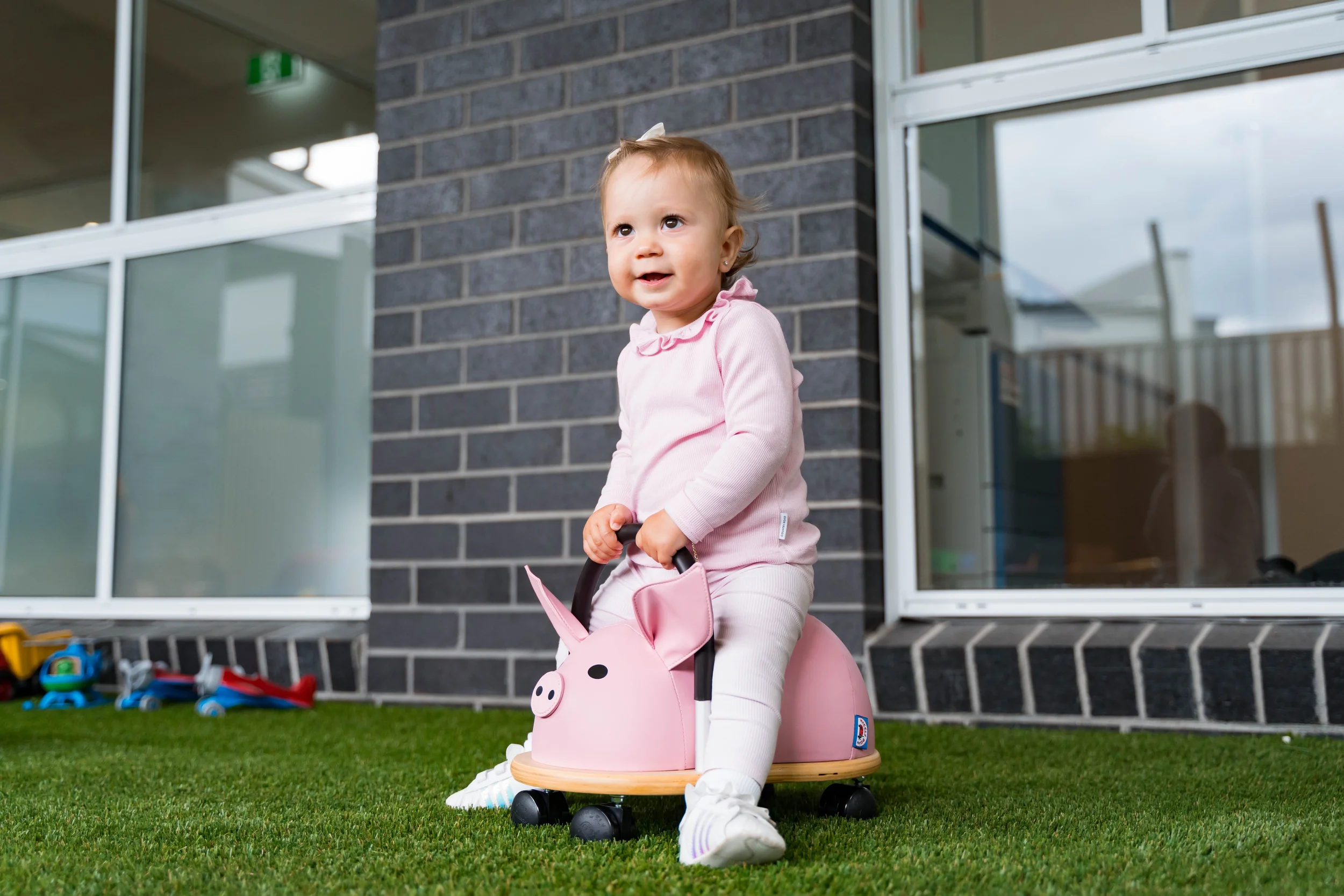
Suitable indoor and outdoor experiences
Respectful nappy-changing routines
Close observation of communication cues
Detailed family communication
Share the details that educators cannot guess
Before your baby starts, tell educators:
How they show hunger and tiredness
How they usually fall asleep
Which sounds, words or songs comfort them
Their bottle and feeding routine
Foods already introduced
Allergies or medical requirements
How they respond to unfamiliar adults
What movement skills they are developing
What makes them laugh
What usually makes them distressed
A small detail can be extremely useful.
You may know that your baby rubs one ear when tired or becomes quiet rather than crying when hungry. An educator cannot recognise that pattern unless they share it or have time to learn it.
At Kids Central, the Billy Button Nursery Program supports children from six weeks to two years through qualified educators, age-appropriate environments and regular communication with families. (kidscentralelc.com.au)
Childcare for Toddlers
Toddlers are developing independence faster than they can manage it.
They may know exactly what they want but lack the words, physical control or patience to make it happen.
This is why the toddler years can include:
Strong emotional reactions
Repeated requests to do things alone
Difficulty waiting
Grabbing
Biting or pushing
Rapid language development
Constant movement
Strong attachments to routines
Frustration during transitions
A quality toddler program does not treat these experiences as evidence that children are deliberately difficult.
Educators should help toddlers build skills they do not yet possess.
That may involve giving words for a feeling, helping children take turns, changing an overcrowded play space or offering enough time for a toddler to attempt a self-care task.
Look for meaningful movement
Toddlers need opportunities to:
Climb
Carry
Push
Pull
Balance
Fill and empty
Dig
Pour
Run
Dance
Use their hands in increasingly precise ways
Movement is not separate from learning.
A toddler carrying water between containers may be exploring volume, weight, cause and effect and physical coordination at the same time.
The Lilly Pilly Toddler Program at Kids Central includes stories, music, art, movement, outdoor experiences and learning through play. (kidscentralelc.com.au)
Childcare for Preschool-Aged Children
Preschool-aged children are developing increasingly complex ideas.
They may create detailed imaginary worlds, negotiate rules, ask persistent questions and become interested in names, numbers, symbols and how communities work.
A preschool program should give those ideas somewhere to grow.
That can involve:
Storytelling
Construction
Dramatic play
Early writing
Drawing
Measurement
Counting
Nature investigation
Music
Group discussion
Physical challenge
Problem-solving
Projects that continue across several days
The educator’s role is not to decide every outcome.
Educators observe what children are thinking and decide when to add language, materials, questions or support.
Kids Central’s Desert Rose Preschool Program combines planned and child-led experiences, indoor and outdoor play, social development and preparation for school. (kidscentralelc.com.au)
What Play-Based Learning Really Means
Play-based learning is sometimes misunderstood as unplanned free time.
Quality play-based learning involves intention.
An educator may notice several children building roads and add:
Street signs
Maps
Measuring tools
Photographs of local streets
Different construction materials
Books about transport
Paper for creating plans
The children remain active in the experience, but the educator helps extend what is possible.
Through that one interest, children may explore:
Language
Measurement
Shape
Position
Community roles
Cooperation
Drawing
Problem-solving
Negotiation
The National Quality Standard expects educational programs to be child-centred, stimulating and designed to extend each child’s learning and development. (acecqa.gov.au)
A useful question during a centre tour is:
“Can you show me how something the children became interested in developed over time?”
That answer will usually tell you more than a weekly activity calendar.
Understanding Approved Childcare Services
An approved early childhood education and care service operates within a national and state regulatory system.
In New South Wales, services are regulated and assessed by the NSW Early Childhood Regulator. Families can check service types, addresses, hours and quality information through official service finders. (education.nsw.gov.au)
An approved service is expected to meet responsibilities involving:
Staffing
Qualifications
Supervision
Health and safety
Educational programs
Record keeping
Policies
Family communication
Physical environments
Governance
This does not mean families should assume that every approved service provides an identical experience.
Regulation creates a framework. Leadership, staffing, relationships and daily practice determine how the service feels within that framework.
The National Quality Standard
The National Quality Standard is the national benchmark used to assess early childhood education and care services.
It contains seven quality areas:
Educational program and practice
Children’s health and safety
Physical environment
Staffing arrangements
Relationships with children
Collaborative partnerships with families and communities
Governance and leadership
Services receive a rating for each area and an overall rating. (acecqa.gov.au)
The main ratings include:
Significant Improvement Required
Working Towards National Quality Standard
Meeting National Quality Standard
Exceeding National Quality Standard
Excellent
Meeting the National Quality Standard means a service is providing quality education and care across all seven areas. Exceeding means the service goes beyond the standard in at least four areas. The Excellent rating is separately awarded by ACECQA. (education.nsw.gov.au)
How to use a rating
Use the rating to guide your questions.
Ask:
When was the service last assessed?
Which areas were strongest?
Were any areas rated Working Towards?
What improvements has the service made since assessment?
Can families see the Quality Improvement Plan?
How is feedback included in improvement planning?
A rating should not replace a visit.
The service may have experienced changes since its assessment, including new leadership, educator turnover or improvements to its environment.
You still need to observe current practice.
How to Find and Compare Services
TheStartingBlocks childcare finder allows families to search for approved services and view available quality information.
You can begin with several realistic areas rather than one postcode.
For example, a Western Sydney family may consider care:
Near home
Along the route to work
Near a grandparent
Close to an older child’s school
Near a railway station or a major road
Within a suburb where available days are more likely
Once you have a shortlist, compare each service using the same categories:
Location
Hours
Available days
Age groups
Fees
Inclusions
Quality rating
Educator qualifications
Ratios
Orientation
Meals
Indoor and outdoor environments
Inclusion
Communication
School readiness
Holiday closures
Notice periods
Using the same headings prevents one impressive feature from dominating the entire decision.
Educator Qualifications
Early childhood education involves professional knowledge.
Educators need to understand areas such as:
Child development
Learning through play
Safety
Supervision
Attachment and relationships
Observation
Planning
Inclusion
Health
Behaviour as communication
Family partnerships
Professional responsibilities
Qualification requirements vary according to the educator’s role.
Centre-based services for children, preschool-aged or younger, must meet requirements involving Certificate III, diploma-level educators, and access to or employment of an early childhood teacher.
Ask the centre:
What qualifications do educators hold?
Who is the early childhood teacher?
Who leads each room?
Which educators are studying?
How is professional development supported?
How are new educators introduced?
What training covers child safety, first aid and allergies?
How does management support the team?
Qualifications matter, but they are not the only thing to observe.
Look for professional knowledge combined with warmth, patience and good judgement.
Educator-to-Child Ratios in New South Wales
Minimum centre-based ratios in New South Wales are generally:
One educator for every four children from birth to 24 months
One educator for every five children over 24 months and under 36 months
One educator for every ten children aged 36 months through preschool age
Educators must be physically present and directly involved in providing education and care to count towards the ratio. Centre-based ratios are calculated across the whole service, while adequate supervision must still be maintained. (acecqa.gov.au)
Knowing the minimum is useful.
The next question is how the centre organises its people.
Ask what happens during:
Educator breaks
Early arrivals
Late collections
Nappy changes
Toileting
Meals
Sleep and rest
Movement outdoors
Staff illness
Incidents
Times when several children need support
A child does not experience the ratio as a number.
They experience whether an adult is available.
What to Watch During a Centre Tour
A tour is more useful when you observe first, then ask for explanations.
Watch how children and educators respond to one another.
Notice:
Whether children approach educators
Whether educators use children’s names
How long adults allow children to answer
Whether upset children receive calm attention
How boundaries are explained
Whether educators appear constantly rushed
Whether quieter children are noticed
How personal care is handled
Whether children have meaningful choices
How the manager interacts with the rooms
Do not expect a centre to be silent or perfectly tidy.
Young children move, create, eat, communicate and sometimes disagree.
The useful question is whether the activity feels purposeful and whether adults remain available.
Indoor Learning Environments
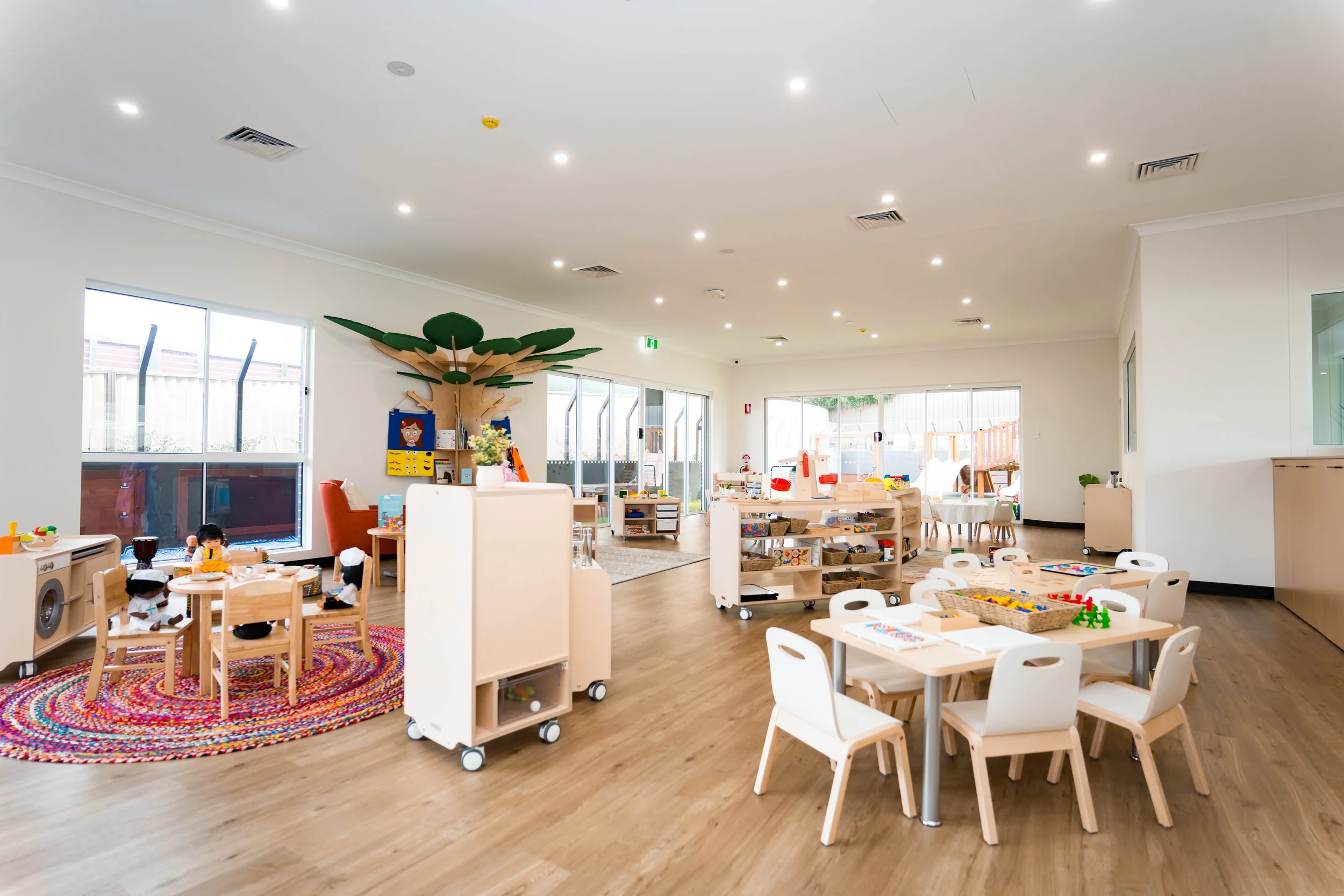
An indoor room should work for children, not only look attractive to adults.
From a child’s height, ask:
Can they reach resources?
Can they see what is available?
Is there room to move safely?
Is there somewhere quieter?
Can materials be used in different ways?
Are children represented in the displays?
Is the room crowded with furniture?
Can educators supervise the whole space?
Are babies given enough safe floor time?
Can children manage some routines independently?
A well-planned room may provide areas for:
Construction
Books
Creative experiences
Dramatic play
Sensory exploration
Music
Small-group conversation
Quiet concentration
Rest
Movement
Not every child will use the room in the same way.
A child who enjoys busy group play and a child who prefers to observe quietly, should both be able to participate.
Natural and Open-Ended Resources
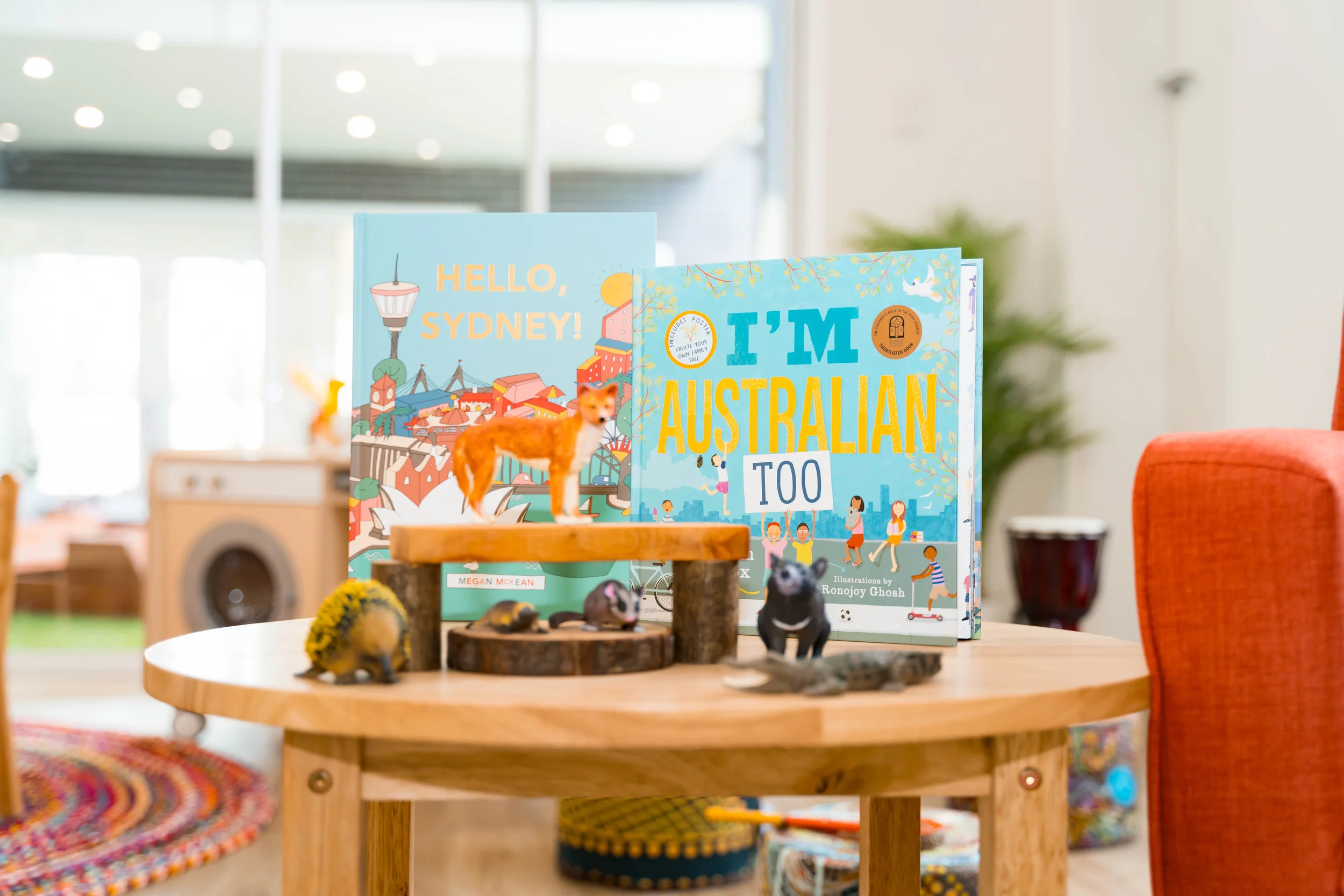
Natural and open-ended resources may include:
Timber
Leaves
Stones
Shells
Sand
Water
Fabric
Clay
Recycled materials
Loose parts
These materials can support imagination because they do not always have one fixed purpose.
A timber piece might become:
A bridge
A phone
Food in a pretend kitchen
Part of a road
A building material
A piece in a pattern
The child makes more of the decisions.
Ask whether natural resources are genuinely available during everyday play or mainly displayed to create an attractive room.
At Kids Central, natural resources and carefully planned indoor and outdoor areas form part of the intended educational approach.
Outdoor Learning
Outdoor time should not be treated as a break from the educational program.
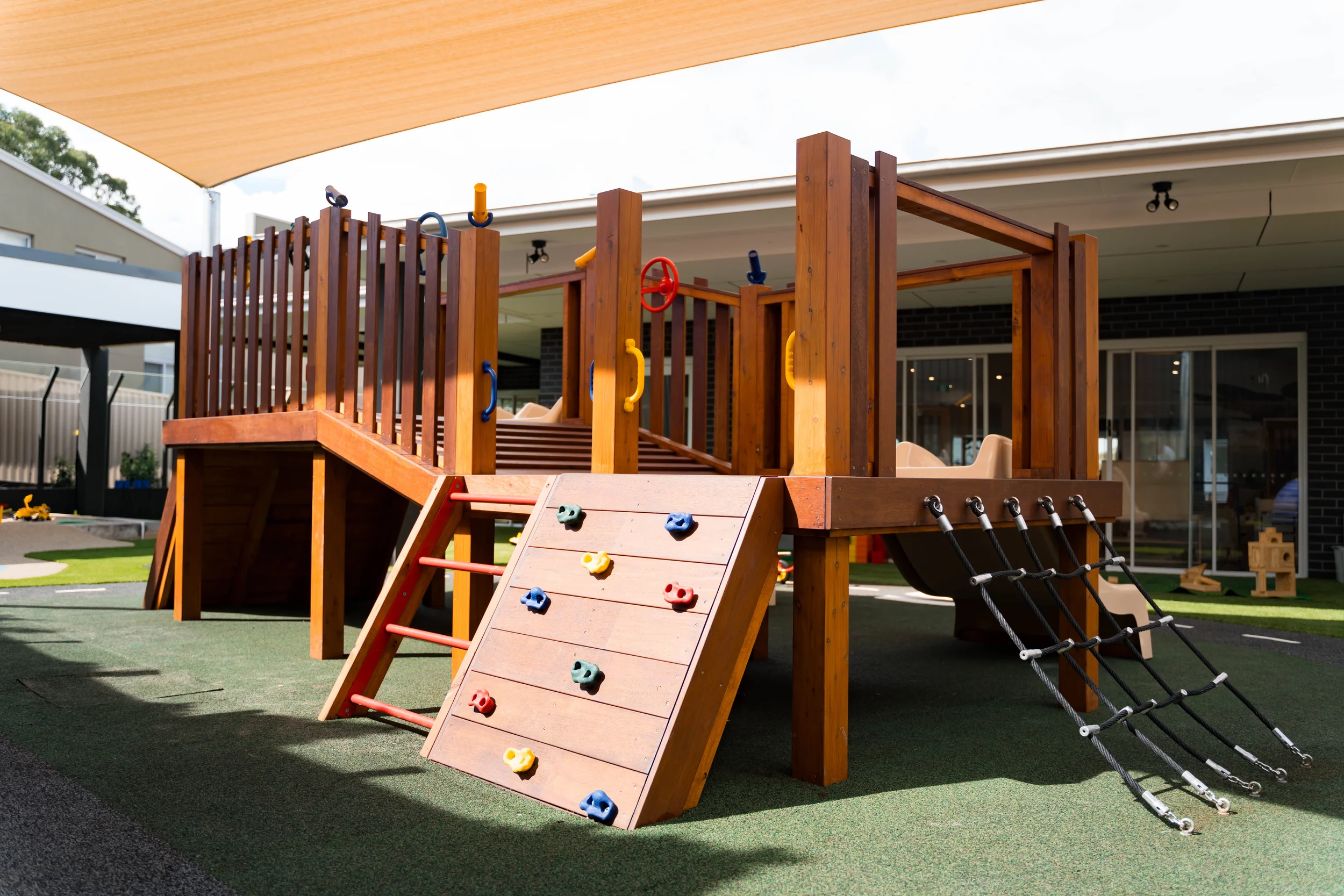
Children can learn outdoors through:
Running
Climbing
Balancing
Gardening
Water
Sand
Building
Nature observation
Drawing
Group games
Imaginative play
Safe physical challenge
Quiet conversation
Ask:
How often do children go outside?
Can indoor and outdoor play occur together?
What happens during hot or wet weather?
How is shade provided?
Are there spaces for babies?
Is all outdoor activity based on fixed equipment?
Can children engage with nature?
How are risks assessed?
Are children supported to challenge themselves safely?
A large outdoor area is not automatically a thoughtful one.
The value comes from how children use it and how educators support exploration.
Health, Safety and Cleanliness
A clean appearance is reassuring, but parents need to understand the systems behind it.
Ask the centre to explain:
Secure entry
Authorised collectors
Supervision
Cleaning
Handwashing
Nappy changes
Toileting
Illness
Exclusion periods
Medication
First aid
Allergies
Emergency procedures
Sleep and rest
Sun protection
Incident reporting
Child-protection training
Photography and personal-device policies
You should not feel uncomfortable asking detailed questions.
A professional service should be able to explain how its procedures work during an ordinary day.
Secure collection
Confirm:
Who is authorised to collect
How identification is checked
How collection changes are communicated
What happens during family disputes
Whether children can leave with an unfamiliar person
How late collection is handled
Who has access to the building
These procedures may occasionally feel inconvenient, but they exist to protect children.
Illness
Ask what happens when a child:
Develops a fever
Vomits
Has diarrhoea
Develops a rash
Appears unusually tired
Has an infectious illness
Needs to be collected early
Find out how long children may need to remain away and whether medical clearance is sometimes required.
Families should receive the illness policy before enrolment, rather than discovering it during an already stressful morning.
Medication
Services should require clear authorisation and appropriate storage for medication.
Tell the centre about:
Prescription medication
Asthma
Anaphylaxis
Diabetes
Epilepsy
Ongoing medical conditions
Emergency medication
Relevant healthcare plans
Do not place medication in a child’s bag without handing it over in accordance with the centre’s procedure.
Allergies and Food Safety
Allergy management requires careful communication among families, educators, and food staff.
Ask:
How are allergies recorded?
Who can see the child’s allergy information?
How are educators trained?
Where is emergency medication stored?
How is cross-contamination reduced?
How are menu substitutions planned?
What happens during celebrations?
How are new or relief educators informed?
When will parents be contacted?
Kids Central’s published allergy process includes alternative ingredients, allergy information for kitchen and other staff and procedures intended to avoid cross-contamination. (kidscentralelc.com.au)
Families should keep allergy and medical information up to date.
A centre cannot safely follow instructions it has not received.
Sleep and Rest
Sleep requirements change considerably from infancy through preschool.
Ask:
How are baby sleep routines discussed?
How are sleeping children supervised?
What sleep equipment is used?
What comfort items are permitted?
How are sleep times recorded?
What happens if a child does not sleep?
Are preschoolers required to stay in a bed?
Is a quiet alternative available?
How are family or medical instructions considered?
Rest does not need to mean sleep.
A child who no longer naps may still need somewhere calm to read, listen to music, or let their body slow down.
Personal sleep preferences must still operate within safe service procedures.
Nutrition and Planned Menus
A child attending long-day care may eat most of their weekday food at the centre.
Ask to see the menu.
Look for:
Variety
Fruit and vegetables
Suitable proteins
Age-appropriate textures
Water availability
Cultural variety
Allergy substitutions
Medical dietary support
How often the menu changes
Then ask about the mealtime itself.
Find out:
Whether children are pressured to eat
How unfamiliar foods are introduced
What happens when a child refuses lunch
How sensory feeding needs are approached
Whether children practise independence
How families learn what their child ate
Whether children sit and talk together
At Kids Central, the current published fee inclusions include five cooked meals each day prepared by an on-site cook. Nappies, wipes, linen and sunscreen are also included. (kidscentralelc.com.au)
Those inclusions can simplify the family morning, but respectful mealtime practice remains just as important as the menu.
Inclusion in Childcare
Inclusion is not achieved simply because a service accepts an enrolment.
A child needs meaningful opportunities to participate, communicate, form relationships and influence their environment.
Children may need support connected to:
Disability
Development
Communication
Mobility
Sensory processing
Behaviour
Medical care
Home language
Culture
Religion
Family structure
Emotional wellbeing
Inclusive practice might involve:
Visual information
Alternative communication
Additional processing time
Adjusting the environment
Different equipment
A quieter space
Changes to an activity
Collaboration with allied health professionals
Key words from a home language
Individual medical planning
Ask:
When should we raise support needs?
Who coordinates inclusion?
Can educators work with therapists?
How are experiences adapted?
Can the room arrangement change?
How are children’s strengths included?
How will our family participate in planning?
What happens if the current approach is not working?
The most revealing part of the answer is often the language used.
Does the service speak mainly about the child as a problem, or does it discuss how the environment and educators can make participation possible?
Culture and Home Language
Western Sydney families bring many languages, histories, faiths and family traditions into early learning services.
A child’s home language should not be treated as something that must disappear before English develops.
Tell educators:
Which languages your child hears
Which language they understand most easily
Important words for food, sleep, toilet, family and help
How their name is pronounced
Who is included in their family
Which cultural or religious practices matter
Whether particular foods or celebrations have significance
Look at whether the centre’s everyday resources reflect different people and families.
Culture should not appear only during a festival week.
It should shape how educators listen, communicate and include family knowledge throughout the year.
Kids Central’s child-safety commitment gives particular attention to Aboriginal children, culturally and linguistically diverse children and children with disabilities. (kidscentralelc.com.au)
Communication With Families
Parents need practical updates, but communication should extend beyond photographs and routine records.
You should know:
Who to speak with
How urgent information is shared
How incidents are reported
When developmental conversations occur
How concerns can be raised
How management follows up
How family feedback affects the program
How staffing changes are communicated
Kids Central uses the secure OWNA app for private updates with families. (kidscentralelc.com.au)
An app can tell you what your child ate or how long they slept.
A relationship helps you understand why they were unsettled, what interested them and whether an educator has noticed a meaningful change.
You need both.
What Childcare Fees May Include
Services set their own fees and inclusions.
A daily rate may cover only education and care, or it may also include:
Meals
Nappies
Wipes
Linen
Sunscreen
Educational programs
Special activities
Excursions
Communication platforms
Ask for a written fee schedule.
Also check:
Enrolment fees
Deposits
Bond requirements
Late fees
Public holiday charges
Absence charges
Notice periods
Holiday discounts
Additional activity costs
Fee increase procedures
Whether fees are charged in advance or arrears
Do not compare daily prices without comparing what is included.
A lower daily rate may require the family to provide food and supplies. A higher advertised rate may include most daily needs.
Child Care Subsidy
The Child Care Subsidy helps eligible families with the cost of approved childcare.
Services Australia states that families generally need to:
Care for a child aged 13 or younger who is not attending secondary school, unless an exemption applies
Use an approved childcare service
Be responsible for paying the fees
Meet residence and immunisation requirements
The amount available depends on the family’s circumstances. (servicesaustralia.gov.au)
Childcare providers do not decide your eligibility.
Check the currentChild Care Subsidy information from Services Australia and complete the required claim through your government account.
Ask the centre to explain the billing process
You may want to know:
When CCS is applied
How the gap fee is collected
What happens while a claim is pending
How absences affect billing
How statements are provided
What happens when your entitlement changes
Who to contact about an incorrect session report
Keep your family income and circumstances up to date with Services Australia.
An estimate that is no longer accurate may affect later balancing.
Joining a Waitlist
Popular days can fill earlier than others.
Tuesday, Wednesday and Thursday are often requested by working families, although availability varies by service and age group.
When joining a waitlist, provide accurate information about:
Your child’s date of birth
Required days
Preferred start date
Flexibility
Siblings
Medical or inclusion needs
Contact information
Ask:
Is this an expression of interest or a formal waitlist?
Is there a waitlist fee?
How are places offered?
How long do families have to respond?
Can we update our required days?
Does joining guarantee a place?
Are places prioritised according to a policy?
When should we follow up?
Do not make employment or care decisions on the assumption that a place has been secured until you have received and accepted a formal offer.
What You May Need for Enrolment
Requirements vary, but services may ask for:
Child and parent identification
Birth information
Contact details
Emergency contacts
Authorised collectors
Immunisation information
Medical plans
Allergy plans
Medication details
Court or parenting orders
Cultural and language information
Developmental or disability information
Child Care Subsidy details
Payment authority
Routine information
Previous care history
Provide documents early.
A service may need time to arrange staff training, review medical information or plan reasonable support before commencement.
Orientation Before the First Day
Orientation should be more than completing paperwork.
It allows:
Your child to recognise the environment
Educators to begin learning their communication
Families to explain routines
Questions to be answered
Comfort strategies to be discussed
The first separation to be planned
At Kids Central, the client-approved approach includes orientation visits, spending time getting to know the child before they start and suggesting a family photo where it may help.
A family photo gives a child a visible connection with home.
Educators can use it to talk about the people who matter and to remind the child that their family will return.
What to tell educators
Share:
Sleep routines
Eating patterns
Toileting
Home languages
Comfort strategies
Interests
Fears
Sensory preferences
Previous separations
Family changes
Medical information
Developmental concerns
How your child asks for help
Do not minimise something because you worry it may make your child sound difficult.
Accurate information helps educators prepare.
What to Pack
The centre should provide a clear list.
Depending on age and inclusions, your child may need:
A labelled water bottle
A labelled hat
Spare clothing
Underwear
Weather-appropriate layers
Bottles or formula
A comfort item
A family photograph
Medical items supplied according to centre procedures
A bag your child can recognise
Label everything.
Childcare rooms contain many similar jumpers, hats, bottles and bags.
Choose clothing that allows your child to move, play and participate without worrying about stains.
The First Morning
Give yourself more time than usual.
Your child may refuse breakfast, become upset during the journey or cling to you when the centre suddenly feels real.
That does not mean the choice was wrong.
Share any relevant information with the educator:
Poor sleep
Reduced appetite
Illness
A difficult morning
A different collector
A change at home
Medication updates
Use a clear goodbye.
Do not disappear secretly.
You might say:
“I am going now. Your educator will stay with you. I will come back after your day.”
Your child may cry.
The goal of preparation is not to prevent every feeling. It is to make the separation honest, supported and predictable.
How Long Does Settling Take?
There is no single timeframe.
Some children engage quickly. Others need several weeks to build trust.
A child may also appear settled for several days and become upset later once they fully understand the routine.
Look for gradual changes:
Recognising educators
Returning to a favourite activity
Accepting comfort
Eating more comfortably
Referring to another child
Understanding the day’s rhythm
Recovering sooner after goodbye
Showing an educator something
Talking about the centre at home
Ask educators what happens after you leave.
Do not judge the entire experience from the emotion at the door alone.
When Settling Needs a New Plan
Speak with the centre when:
Distress remains intense
Your child does not recover after separation
They refuse food or fluids
Sleep is severely disrupted
They appear frightened of a particular person or area
Their behaviour changes significantly
They repeatedly say they feel unsafe
They cannot participate across the day
Communication from the centre is unclear
A revised plan might include:
More orientation
Shorter initial days
A different handover
A particular educator receiving the child
A visual routine
A family photograph
A comfort item
Additional professional support
Children should not be expected to endure distress indefinitely because adults have decided they simply need to get used to it.
School Readiness
School readiness includes far more than reading, writing and counting.
Children benefit from developing:
Communication
Emotional regulation
Physical coordination
Independence
Curiosity
Relationships
Group participation
Responsibility for belongings
Confidence asking for help
Persistence
Early literacy and numeracy can grow through play.
A child may encounter literacy while:
Listening to stories
Recognising a name
Making signs
Singing rhymes
Dictating a story
Explaining a drawing
They may encounter numeracy while:
Counting plates
Comparing towers
Measuring water
Sharing resources
Noticing patterns
Discussing time and sequence
Kids Central’sTransition to School Program combines social, emotional, physical and cognitive preparation with play-based early literacy, numeracy and growing independence. (kidscentralelc.com.au)
Changing Childcare Centres
Families change services for many reasons.
You may move, change employment, need different days or decide the current arrangement no longer suits your child.
Before moving, consider:
Whether the concern can be addressed
Notice periods
Outstanding fees
CCS session reporting
Transition information
Returning belongings
Medical documents
How the change will be explained to your child
Orientation at the new service
Avoid criticising the old centre in front of your child.
You can say:
“You will be going to a different centre. We will visit first and learn who will care for you.”
A child may miss previous educators and friends even when the change is appropriate.
Both things can be true.
Raising a Concern or Complaint
You should know how to raise concerns before you need the process.
Ask for the service’s complaints policy.
Begin with the person closest to the issue when appropriate, but speak with management when the matter involves safety, repeated concerns or an educator relationship that makes direct discussion difficult.
Keep notes covering:
What happened
When it happened
Who was present
What your child said
What you observed
Who you contacted
The response
What follow-up was promised
A professional service should not punish or isolate a family for asking a reasonable question.
If a concern is not resolved or relates to regulation and safety, families may seek information from the relevant NSW authority.
Childcare in Western Sydney Needs to Work Locally
Western Sydney is not one uniform childcare market.
A family in Edensor Park may need different routes, hours and community connections from a family in Colyton, Penrith, Liverpool or Parramatta.
The practical fit may depend on:
Traffic
Public transport
Work locations
School drop-offs
Extended family
Shift work
Available places
Home languages
Community connections
Before and after school arrangements
Do not choose a centre because it appears close in kilometres alone.
Travel the route during the hours you will use it.
Test:
Morning traffic
Parking
Walking access
Collection time
Whether another authorised adult can manage the journey
How the route connects with work or school
What happens if one car is unavailable
The right childcare service should support family life rather than create an unmanageable journey twice each day.
Kids Central in Western Sydney
Kids Central currently operates at 79 Swan Road, Edensor Park, from 7.00 am to 6.00 pm on weekdays.
The centre provides:
The live site highlights qualified educators, family communication, secure entry, health and safety practices, purpose-built environments and individualised learning. (kidscentralelc.com.au)
A newKids Central Colyton centre is announced as coming in 2026.
The planned Colyton service includes:
Care from six weeks to six years
Purpose-built learning environments
Experienced educators
School-readiness support
Healthy daily meals
Nappies and wipes
Sun-safety provisions
The precise opening date, street address, operating hours and fee schedule have not yet been published. Families can register an Expression of Interest while waiting for further details. (kidscentralelc.com.au)
A Final Checklist Before You Accept a Place
The service
Is it approved?
Have I checked the quality rating?
Do the available days work?
Are the hours practical?
Have I travelled the route?
Do I understand the fees and inclusions?
Have I read the enrolment agreement?
The educators
Who will know my child?
What qualifications do they hold?
Who leads the room?
Who is the early childhood teacher?
How stable is the team?
Is management involved in daily practice?
The child’s day
How are meals handled?
What happens during sleep and rest?
How much outdoor time is available?
How is play extended?
Are quieter spaces available?
Can children select resources?
How are difficult emotions supported?
Safety
How does secure entry work?
Who can collect?
How are allergies managed?
What happens during illness?
How are incidents communicated?
How are sleeping children supervised?
What child-safety training is completed?
Inclusion
How will the centre support my child’s communication?
Is our home language welcomed?
Can the environment be adapted?
Can educators work with allied health professionals?
How will our family contribute to planning?
Commencement
How many orientation visits are available?
What should we bring?
Can we provide a family photo?
Who will receive my child on the first day?
When will the centre update me?
What happens if settling remains difficult?
Questions Families Commonly Ask
How early should I begin looking for childcare?
Begin as soon as you know you may need care, particularly when your required days are inflexible.
Joining a waitlist does not always guarantee a place, so keep several realistic options open until you receive a formal offer.
How many days should my child attend?
There is no universal number.
Consider your family schedule, affordability, your child’s temperament and the consistency of attendance. Ask how the educational program operates across the week and whether experiences continue over several days.
Is a bigger centre better?
Not automatically.
A larger centre may have more rooms, educators and facilities. A smaller service may feel more intimate. Relationships, leadership and daily practice matter more than capacity alone.
Should siblings attend the same centre?
One location can simplify travel and help siblings share a sense of familiarity.
However, each child’s needs still matter. A centre that suits one sibling may not automatically suit another.
What if my child has never been away from me?
Tell the centre early.
Use orientation, practise short separations with trusted people and share what helps your child feel safe. A child who needs time is not failing at childcare.
Can my child attend if they do not speak English?
Yes.
Continue using your home language. Share important words and ask how educators will support communication, representation and belonging.
What happens if my child has additional needs?
Raise the conversation before enrolment.
Provide relevant professional information, and explain your child’s strengths, interests, communication, and effective support strategies.
Is childcare only useful for working parents?
No.
Families use early learning for work, study, development, social connection, respite and many other reasons.
A family does not need to justify wanting high-quality early learning.
The Most Important Part of the Decision
Childcare will become part of your child’s ordinary life.
They will not experience it as a website, a fee schedule or a quality certificate.
They will experience who greets them.
They will experience whether someone understands their signals, whether they can find a place in the room and whether help is available when something feels difficult.
They will experience the tone used during meals, toileting, conflict and separation.
Look at the facilities, but pay closer attention to the people.
Read the program, but ask how your child could influence it.
Check the ratios, but notice whether educators are available.
Review the menu, but ask how a child who refuses food is treated.
Check the communication platform, but make sure someone will have an honest conversation with you.
At Kids Central Early Learning Centre, we want to know the child behind the enrolment form.
Tell us about their routines, language, interests, culture, strengths and the parts of starting care that concern you.
You do not need to understand the entire childcare system before contacting us.
Bring the life your family actually lives, and we can begin the conversation there.